
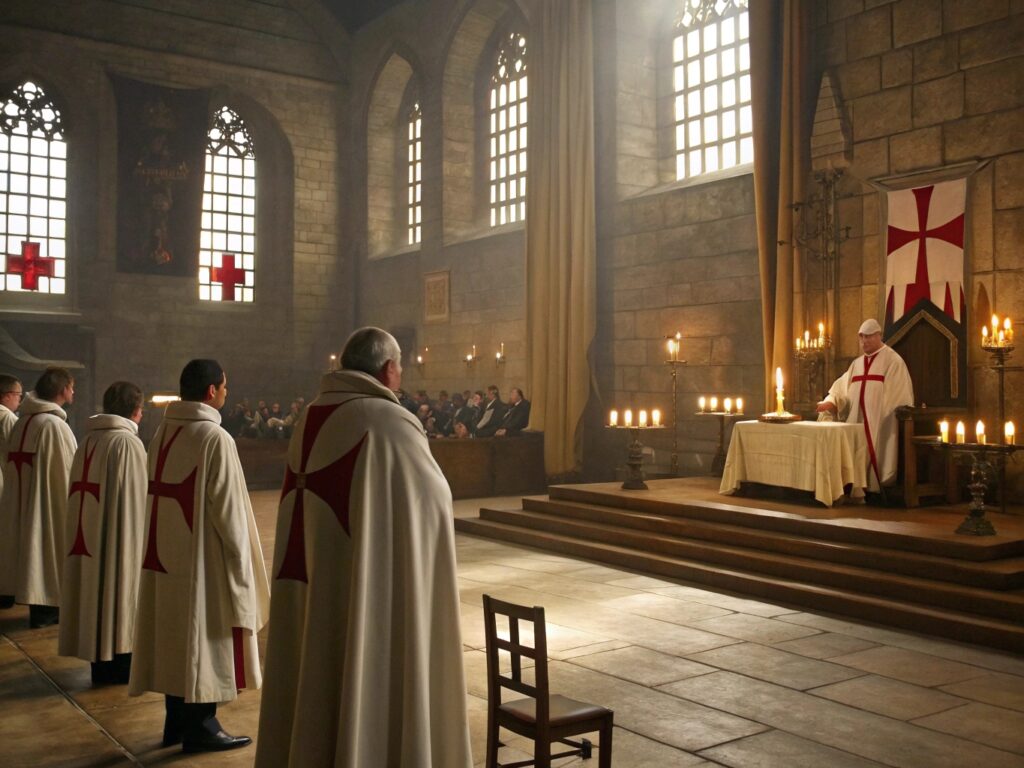
In the early 14th century, one of the most feared institutions in Europe—the Inquisition—turned its gaze not toward heretical peasants or rogue monks, but toward one of Christendom’s most powerful military orders: the Knights Templar. The result was a campaign of arrests, confessions under torture, and executions that would leave a stain on ecclesiastical justice and birth centuries of myth and mystery.
The Trial of the Templars was not simply a question of faith or doctrine. It was a political chess move, driven by debt, fear, power struggles, and institutional corruption. This article unpacks what the Inquisition got wrong—not just legally and ethically, but morally and theologically—when it dismantled one of the most influential orders in medieval Europe.
The Rise of the Knights Templar
Founded in 1119 after the First Crusade, the Poor Fellow-Soldiers of Christ and of the Temple of Solomon—or Templars—began as humble protectors of pilgrims in the Holy Land. But over time, they evolved into an elite warrior class, international bankers, and landholders with unprecedented independence.
By the 13th century, the Templars operated outside the authority of local kings and bishops. They answered only to the Pope, controlled extensive assets, and had their own fleet, castles, and legal system.
Their wealth and autonomy made them indispensable during the Crusades—but also deeply threatening in an increasingly centralized Europe.
The Political Motive Behind the Persecution
When the last Crusader stronghold fell in 1291, the Templars lost their primary battlefield purpose. But they remained rich, influential, and untouchable. This didn’t sit well with King Philip IV of France—nicknamed “Philip the Fair.”
Philip was heavily indebted to the Templars due to wars with England and political expenses. He had already debased currency and persecuted Jewish lenders. Now, he saw the Templars as both a financial solution and a threat to royal authority.
With a mix of ambition and desperation, he weaponized the Inquisition.
On October 13, 1307—a date that lives in infamy—all Templars in France were arrested in a synchronized pre-dawn raid. The charges? Heresy, idolatry, sodomy, devil worship, spitting on the cross, and secret rituals.
The Inquisition’s Errors and Abuses
1. Coerced Confessions Through Torture
The primary tool used to convict the Templars was torture. Inquisitors employed:
-
The strappado (suspending by the wrists);
-
Burning the soles of the feet;
-
Sleep deprivation and starvation.
After days or weeks of agony, many Templars confessed to whatever was asked. Some admitted to denying Christ, worshipping a mysterious head called Baphomet, or kissing fellow knights in ritualistic ways.
Modern legal scholars and theologians now agree: confessions under torture are neither reliable nor moral. Yet the Inquisition at the time accepted them as valid evidence, despite canonical law advising against it.
2. Secret Proceedings with No Right to Defense
Templars were denied legal representation and knowledge of their accusers. Many were interrogated in secret, without access to the charges or witnesses.
This violated principles enshrined in canon law and Roman legal tradition, which emphasized public trials, evidence, and the right to confront one’s accuser.
3. Doctrinal Inconsistency
Ironically, the Church itself had previously blessed and empowered the Templars. Popes like Innocent II and Honorius III issued bulls protecting the Order’s privileges.
To suddenly declare the Order heretical without direct theological challenge or ecumenical council was inconsistent with ecclesiastical tradition.
No council of theologians convened to investigate the charges independently. Instead, the Inquisition and French crown collaborated behind closed doors.
The Chinon Parchment: The Vatican’s Hidden Admission
For centuries, it was believed the Catholic Church had found the Templars guilty of heresy. But in 2001, historian Barbara Frale uncovered the Chinon Parchment—a suppressed Vatican document from 1308.
It records the findings of three cardinals sent by Pope Clement V to interrogate Templar Grand Master Jacques de Molay and other leaders. The document reveals:
-
The Templar leaders confessed to minor disciplinary infractions, not heresy.
-
They were granted absolution by the Pope.
-
The Pope concluded they could remain within the Church if properly penanced.
This key piece of evidence, hidden for over 600 years, shows that the Church never officially condemned the Templars as heretics. It was Philip IV, not the Pope, who pressured Clement to dissolve the Order under threat of schism and violence.
Jacques de Molay and the Curse of Innocence
Despite the Pope’s absolution, Philip IV needed a scapegoat. In 1314, after seven years of imprisonment, Jacques de Molay and Geoffroi de Charney were burned alive on an island in the Seine.
Legend says that Molay, moments before his death, cried out from the flames:
“God knows who is wrong and has sinned. Soon a calamity will befall those who have condemned us to death.”
Within a year:
-
Pope Clement V was dead
-
King Philip IV died from a stroke
-
His lineage crumbled within two generations
This tale helped fuel the myth of a Templar curse, but even without supernatural flair, their execution marked a dark betrayal of justice.

Myths vs Reality: What the Inquisition Got Flat-Out Wrong
While some of the accusations against the Templars were vaguely plausible (ritual secrecy, internal discipline), others were fabrications or distortions:
| Accusation | Reality |
|---|---|
| Worship of Baphomet | No evidence exists of a deity called Baphomet before the trials. Likely a misheard or misrecorded name. |
| Sodomy and sexual rituals | Allegations arose under torture and lacked consistency. |
| Spitting on the cross | Some admitted doing so in hazing rituals—likely as a test of courage, not heresy. |
| Idolatry | No idols were ever found. Descriptions of a “mysterious head” varied wildly. |
Legacy of the Templar Trial
The destruction of the Templars sent shockwaves through Europe. Other military orders like the Hospitallers and Teutonic Knights became more cautious. Royal power grew while the papacy, humiliated and manipulated, began to lose credibility.
But the Templars’ mysterious end also captured the imagination of generations:
-
Freemasons claimed Templar lineage
-
Occult writers connected them to hidden knowledge
-
Fictional portrayals (from Assassin’s Creed to The Da Vinci Code) painted them as guardians of esoteric truths
Behind the myths lies a historical truth: The Templars were not heretics. They were victims of a system that prioritized power over truth.
Conclusion: A Trial of Politics, Not Faith
The Inquisition’s campaign against the Knights Templar was not about rooting out heresy. It was about consolidating royal control, seizing wealth, and neutralizing a powerful institution that stood outside the reach of monarchs.
By today’s standards—and even by the standards of 14th-century canon law—the Templars were denied justice. They were accused without evidence, tortured into confession, and executed for crimes they likely never committed.
In deconstructing the trial of the Templars, we find not just a miscarriage of medieval justice—but a cautionary tale about how religious authority can be bent by political ambition.
The true sin of the Inquisition wasn’t heresy. It was obedience to fear, silence in the face of power, and betrayal of the very moral order it claimed to uphold.