
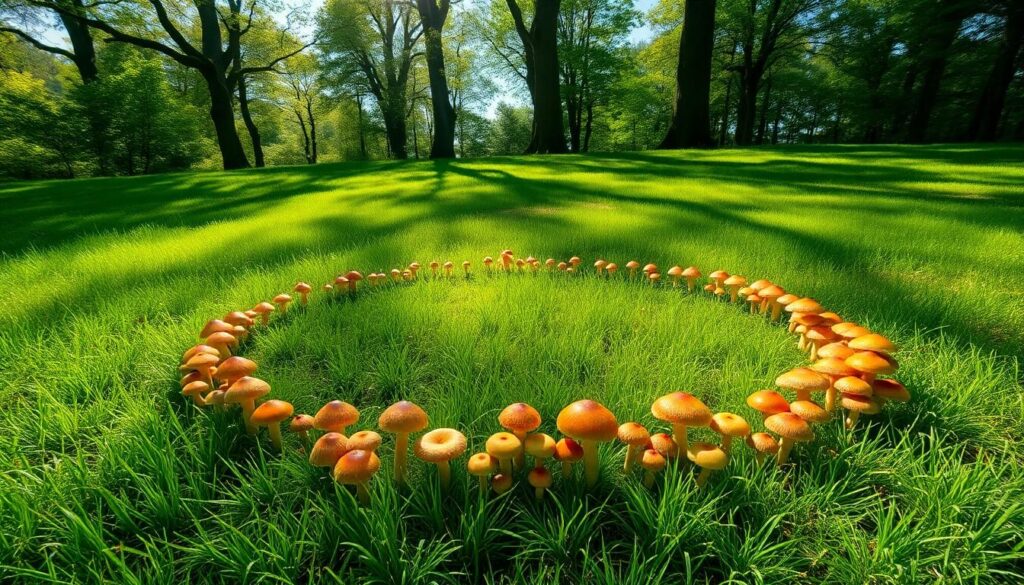
Mysterious rings of mushrooms known as fairy circles or fae rings have captivated the human imagination for centuries. These naturally occurring phenomena appear in folklore worldwide and are often associated with magical creatures, particularly the fae folk who supposedly dance within these enchanted circles under moonlight.
While science explains these rings as the natural growth pattern of fungal colonies expanding outward year after year, many cultures still hold onto the mystical beliefs surrounding them. From European tales warning travelers to avoid stepping inside these circles to Indigenous stories celebrating them as sacred spaces, fae circles continue to bridge the gap between scientific understanding and magical folklore. These fascinating formations serve as a reminder that nature’s wonders can inspire rational explanations and enchanting mythology.
What Are Fae Circles in Folklore and Mythology
Fae circles are naturally occurring rings of mushrooms that ancient cultures believed served as magical portals and gathering places for supernatural beings. These formations appear in folklore across multiple cultures with varying interpretations of their significance.
Ancient Celtic Origins and Beliefs
Celtic mythology portrays fae circles as sacred spaces where the boundary between the mortal world and the fairy realm grows thin. The circles mark locations where:
- Dancing fairies create magical rings during midnight revelries
- Supernatural beings conduct mystical ceremonies under moonlight
- Mortals risk supernatural encounters if they step inside the ring
- Local crops receive magical blessings when circles appear nearby
- English traditions warn of forced endless dancing for humans who enter
- Welsh communities associate the rings with underground fairy settlements
- Local farmers observe increased fertility in surrounding soil and crops
- Livestock grazing near fae circles reportedly shows improved health
- The formations serve as warning markers of fairy territory
| Culture | Primary Belief | Associated Risk |
|---|---|---|
| English | Fairy dancing grounds | Forced dancing until exhaustion |
| Welsh | Underground fairy homes | Unwanted fairy encounters |
| Celtic | Sacred magical portals | Supernatural entrapment |
The Science Behind Fairy Rings

Fairy rings represent a fascinating natural phenomenon where mushrooms grow in distinctive circular patterns. These formations demonstrate the remarkable growth behavior of underground fungal networks.
Natural Formation Process
Fairy rings emerge through a systematic growth pattern of fungal organisms:
- The formation begins with a single fungal spore establishing its mycelium, an underground network of thread-like hyphae that spreads outward
- As the mycelium expands uniformly in all directions, it creates a circular mat beneath the soil surface
- The fungal network secretes enzymes that break down soil nutrients into absorbable compounds
- The center of the ring dies when nutrients deplete, while the outer edges continue expanding
- This growth pattern results in an ever-widening circle of mushrooms visible above ground
Types of Mushrooms Involved
Several mushroom species participate in fairy ring formation:
- Marasmius oreades (Fairy Ring Champignon)
- Chlorophyllum molybdites (False Parasol)
- Agaricus campestris (Field Mushroom)
- Lycoperdon species (Puffballs)
- Clitocybe nebularis (Clouded Funnel)
| Mushroom Species | Ring Diameter Range | Growth Rate per Year |
|---|---|---|
| Marasmius oreades | 0.5-6 meters | 8-30 centimeters |
| Chlorophyllum molybdites | 2-4 meters | 10-20 centimeters |
| Agaricus campestris | 1-3 meters | 5-15 centimeters |
Each species creates distinctive patterns based on their specific growth characteristics. These fungi typically appear during moist conditions in spring or fall, producing visible mushrooms while their mycelium networks remain active year-round beneath the soil.
Identifying Fairy Rings in Nature

Fairy rings present distinct patterns in natural landscapes across various environments. These fungal formations create recognizable features that distinguish them from random mushroom growth.
Common Locations and Habitats
Fairy rings emerge in three primary habitat types:
- Open Grasslands: Free-forming rings appear in meadows featuring:
- Meadow mushroom clusters
- Gem-studded puffball formations
- Scotch bonnet groupings
- Forest Environments: Tethered rings form through mycorrhizal relationships with:
- Deciduous trees (birch, oak, beech)
- Coniferous species (pine, fir, spruce)
- Arid Regions: Distinct circles manifest in:
- Namib desert landscapes
- Sparse vegetation zones
- Bare ground patches
Visual Characteristics
Fairy rings display identifiable features:
- Ring Formation:
- Perfect circular or arc patterns
- Uniform spacing between mushrooms
- Clear boundary definition
- Growth Patterns:
- The outer edge of active fungi
- The inner zone of darker grass
| Ring Type | Diameter Range | Common Species |
|---|---|---|
| Free Rings | 0.3-6 meters | Meadow mushroom |
| Tethered Rings | 1-12 meters | Mycorrhizal fungi |
| Desert Circles | 2-15 meters | N/A |
Dangers and Superstitions

Fairy rings carry significant warnings in folklore across European cultures. Specific dangers are attributed to these mysterious formations, and ancient tales detail severe consequences for those who dare cross their boundaries.
Historical Warnings
Traditional European folklore presents three primary dangers of fairy rings:
- Forced Dancing: Celtic and English traditions warn of fairies compelling humans to dance until exhaustion or death within the rings.
- Time Distortion: Welsh folklore documents cases of people entering rings for minutes but emerging days or weeks later in human time.
- Agricultural Impact: Dutch farmers’ tales indicate livestock passing through fairy rings produce sour milk, linking the formations to supernatural interference.
| Culture | Warning Type | Reported Consequence |
|---|---|---|
| Celtic/English | Physical | Death by exhaustion |
| Welsh | Temporal | Time displacement |
| Dutch | Agricultural | Spoiled dairy products |
- Toxic Mushrooms: Several fairy ring mushroom species contain dangerous compounds that cause severe illness when ingested.
- Soil Disruption: The expanding mycelium network creates nutrient-poor zones affecting plant growth patterns.
- Lawn Damage: Fairy rings in residential areas damage grass uniformity through nutrient depletion.
| Concern Type | Impact Area | Effect |
|---|---|---|
| Toxicity | Human Health | Poisoning risk |
| Agricultural | Soil Health | Nutrient depletion |
| Aesthetic | Landscaping | Visible grass damage |
Fae Circles in Modern Culture
Fae circles remain significant in contemporary culture through various artistic mediums and spiritual practices. Their mystical allure inspires creative works and modern interpretations of ancient traditions.
Literature and Art
Modern literature transforms traditional fae circle mythology through urban fantasy and contemporary retellings. Holly Black’s “Modern Faerie Tales” series portrays fae circles as power centers in gritty urban settings, while Julie Kagawa’s “Iron Fey” series integrates these magical formations into modern narratives. Contemporary artists depict fae circles in diverse mediums, from digital illustrations to traditional paintings, often emphasizing their ethereal nature through luminescent effects and mysterious atmospheres.
Contemporary Pagan Practices
Modern pagan communities incorporate fae circles into their spiritual rituals and ceremonies. Practitioners create temporary sacred circles using natural materials like stones, flowers, or mushrooms to establish connections with nature spirits. These circles serve as focal points for meditation, offerings, and seasonal celebrations that honor the fae folk. Neo-pagan traditions often blend historical folklore with modern interpretations, using fae circles as spaces for spiritual work while respecting their traditional significance as boundaries between worlds.
Conclusion
Fairy circles are remarkable natural phenomena that bridge the gap between science and folklore. Their perfect circular formations continue to captivate researchers and storytellers while enriching cultural narratives worldwide.
Whether viewed through the lens of scientific mycology or ancient folklore, these mysterious rings maintain their ability to spark wonder and imagination. Their enduring presence in modern culture through literature, art, and spiritual practices proves that fae circles remain as enchanting today as they were centuries ago.
Understanding these formations through scientific study and cultural interpretation offers a unique perspective on how humanity continues to find magic in the natural world.