
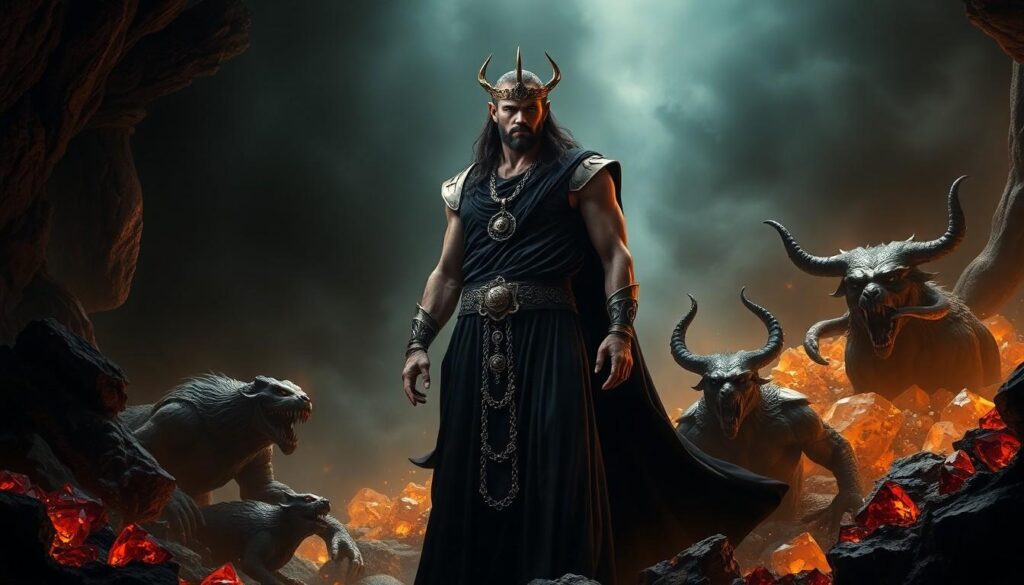
Hades, the formidable ruler of the Underworld in Greek mythology, possesses an arsenal of divine powers that make him one of the most feared and respected gods. As one of the three prominent Olympian brothers alongside Zeus and Poseidon, his abilities extend far beyond simply governing the realm of the dead.
From his power to remain invisible using his legendary helmet of darkness to his absolute control over the souls of the deceased, Hades wields capabilities that even other gods find intimidating. His dominion over precious metals and gems hidden beneath the earth’s surface has earned him the title “The Rich One,” his ability to manipulate shadows and darkness sets him apart from his celestial counterparts.
Understanding Hades: The Greek God of the Underworld
Hades commands absolute authority over the Greek Underworld, wielding three distinct powers that establish his dominion. His control extends to every aspect of the afterlife, from managing deceased souls to governing underground wealth.
Dominion Over the Dead
The Greek Underworld operates under Hades’ precise control, ensuring souls remain in their designated locations after death. His authority prevents the deceased from escaping to the world of the living, maintaining the natural order between life and death.
Invisibility Through Divine Artifacts
The Helm of Darkness grants Hades complete invisibility, enabling strategic advantages in divine and mortal affairs. This powerful artifact, created by the Cyclops, serves multiple purposes:
- Concealment during warfare
- Covert observation of both mortals and gods
- Strategic lending to other deities like Athena
- Support for heroic quests, as demonstrated by Perseus
Command of Earth’s Treasures
Hades’ influence encompasses all subterranean wealth, earning him recognition as the god of hidden riches. His domain includes:
| Resource Type | Examples |
|---|---|
| Precious Metals | Gold, Silver |
| Natural Resources | Gems, Minerals |
| Agricultural Elements | Fertile Soil |
This vast control over underground resources contributes to Hades’ title as “The Rich One,” reflecting his mastery over material wealth hidden beneath the Earth’s surface. His power extends beyond precious metals, influencing the soil that sustains mortal agriculture.
Control Over Death and the Afterlife

Hades reigns supreme over the Greek underworld, maintaining strict authority over all aspects of the afterlife. His dominion encompasses the vast territories where departed souls reside, though he cannot take lives directly.
The Power of Soul Collection
Hades exercises absolute control over souls entering the underworld, serving as their eternal custodian. His authority prevents unauthorized departures from the realm of the dead, implementing severe punishments for souls attempting to escape or mortals trying to rescue them. This power establishes a clear boundary between the world of the living and the dead, maintaining cosmic order in Greek mythology.
Judgment of Mortal Souls
As ruler of the underworld, Hades oversees the judgment and placement of souls in their appropriate regions within his domain. He collaborates with three appointed judges – Minos, Rhadamanthus, and Aeacus – who determine the final destination of each soul based on their earthly deeds. This systematic approach ensures fair treatment of all souls entering the underworld, whether destined for the Elysian Fields, Tartarus, or the Asphodel Meadows.
| Aspect of Power | Description |
|---|---|
| Soul Control | Complete authority over departed spirits |
| Escape Prevention | Enforcement of strict containment measures |
| Judgment System | Oversight of soul evaluation and placement |
| Territorial Domain | Full control over underworld regions |
Dominion Over Wealth and Precious Metals

Hades’ authority extends beyond the realm of the dead to encompass the earth’s material wealth. His title, “Plouton,” directly translates to “The Wealthy One,” reflecting his supreme control over subterranean treasures.
The Gift of Underground Riches
The underworld god exercises complete dominion over all minerals within the earth’s crust. His influence extends to precious metals like gold, silver, and copper mined from underground deposits. This power includes authority over fertile soil, which ensures abundant crop growth through nutrient-rich earth.
- Natural crystal formations in underground caves
- Raw mineral deposits in deep-earth veins
- Precious stones formed through geological processes
- Rare earth elements essential for modern technology
- Underground mineral springs containing valuable deposits
Invisibility and Shadow Manipulation

Hades’ mastery over invisibility stands as one of his most formidable powers, primarily exercised through his legendary Helm of Darkness. This divine ability enabled him to move undetected through the mortal realm and the depths of the Underworld.
The Helm of Darkness
The Cyclopes forged the Helm of Darkness during the Titanomachy, gifting this powerful artifact to Hades for the war against the Titans. The magical helmet is the source of Hades’ invisibility power, transforming its wearer into an unseen entity. Its divine craftsmanship makes it one of Greek mythology’s most potent magical items.
Ability to Become Unseen
The Helm’s power extends beyond Hades himself, as he frequently shared this magical artifact with other deities and heroes for strategic purposes:
- Perseus utilized the helm during his quest to defeat Medusa, enabling him to approach the Gorgon undetected
- Athena donned the helmet in the Trojan War to assist Diomedes in combat against Ares
- Hermes employed the helm’s powers during his battle with the giant Hippolytus
- The helmet renders its wearer completely invisible to both mortals and immortals
The Helm of Darkness’s versatility demonstrates its significance as a tactical advantage in various mythological conflicts, establishing it as one of the most powerful divine artifacts in Greek mythology.
Command Over Underworld Creatures
Hades exercises supreme authority over all creatures inhabiting the Underworld, commanding an array of mythical beings and maintaining order in his domain. His control extends to guardian creatures and divine entities responsible for various aspects of the afterlife.
Control of Cerberus
Cerberus, the three-headed hound, serves as Hades’ most loyal guardian at the gates of the Underworld. The massive dog prevents unauthorized access to the realm, blocking living beings from entering and deceased souls from escaping. Each of Cerberus’ heads maintains constant vigilance, making the creature an effective sentry under Hades’ direct command.
Authority Over Chthonic Beings
Hades maintains absolute control over multiple divine entities that operate within his realm:
- The Furies (Erinyes) execute justice on his behalf, punishing souls who committed crimes in life
- The Fates (Moirai) operate under his supervision, managing the threads of mortal lives
- Various nymphs inhabit different regions of the Underworld, serving as attendants
- Lesser deities perform specific functions:
- Charon ferries souls across the rivers
- Thanatos delivers the dead to the Underworld
- Hypnos oversees the realm of sleep
These beings form a hierarchical structure with Hades at the apex, ensuring efficient management of the Underworld’s various functions.
Connection to Agriculture and Fertility
Hades’ influence extends beyond the realm of death to encompass agricultural abundance through his control over the earth’s fertile soil. His marriage to Persephone, the goddess of spring growth, directly links the underworld and the cycle of plant life.
The Greeks associated Hades with agricultural prosperity through his alternative name, “Plouton” (The Wealthy One), recognizing his role in:
- Soil Fertility: Managing underground nutrients essential for crop growth
- Mineral Distribution: Controlling mineral deposits that enrich farmland
- Root Systems: Overseeing the underground network where plants develop
- Seasonal Cycles: Influencing crop growth through Persephone’s annual return
This agricultural connection manifests in three key aspects:
- Underground Resources: Hades controls subterranean elements that nourish plants
- Seed Germination: His domain encompasses the darkness where seeds first sprout
- Root Development: His influence affects how plant roots access nutrients
The Greeks honored Hades’ agricultural aspects through specific rituals:
- Offering first fruits of harvests
- Performing ceremonies before planting seasons
- Dedicating portions of grain yields
- Conducting fertility rites in his name
This agricultural role positions Hades as more than just the ruler of the dead, establishing him as a crucial deity in the life cycle, growth, and natural abundance. His command over the earth’s resources directly impacts farming success, crop yields, and land fertility.
Conclusion
Hades is one of Greek mythology’s most formidable deities with an extensive array of divine powers. His command over the Underworld’s invisibility through the Helm of Darkness and control over Earth’s precious resources make him an unparalleled force among the Olympian gods.
These powers establish his dominion over the realm of the dead and demonstrate his crucial role in maintaining cosmic balance. Whether by managing souls governing the Underworld’s inhabitants or influencing agricultural prosperity, Hades’ divine abilities continue to captivate and inspire awe in mythology enthusiasts worldwide.
The depth and breadth of Hades’ powers reflect his status as a feared ruler and a necessary force in the natural order of the ancient Greek world.