
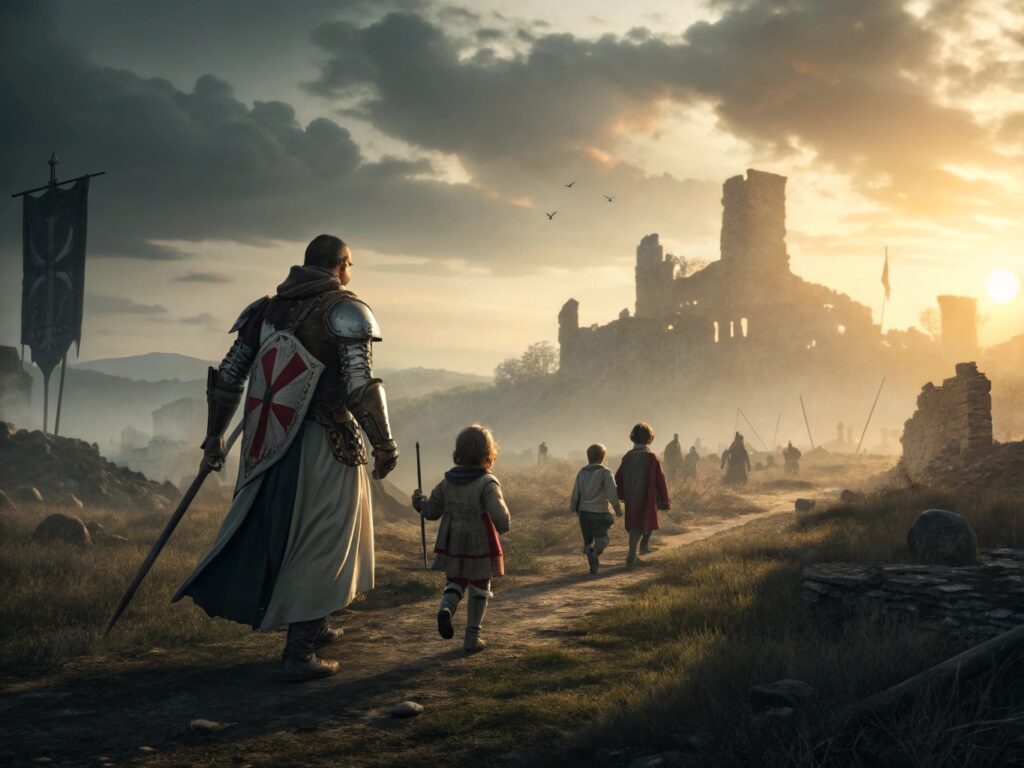
The Knights Templar are most often remembered as fierce warriors and guardians of pilgrims during the Crusades. Yet their role was not limited to battlefield heroics and financial networks. One of the lesser-known aspects of their history involves compassion: the care they extended to abandoned or vulnerable children. The story of the Templar orphans reveals a more human side to the warrior monks, showing how they balanced vows of discipline with acts of mercy. But what truly happened to the Knights Templar children they rescued? Let us explore.
The Orphans of the Crusades
The Crusades left behind immense devastation. Families were torn apart, and countless children were orphaned when fathers fell in battle or mothers succumbed to disease and famine. These orphans of the Crusades were especially vulnerable: left without protection, they faced starvation, slavery, or abuse.
Within this chaos, the Templars often stepped in. While their primary mission was to defend Christian pilgrims and holy sites, evidence suggests that they also took responsibility for some of the most helpless victims of war — children.
A Mission Beyond Warfare
Although their Rule focused on poverty, chastity, and obedience, the Templars operated extensive estates, farms, and commanderies across Europe and the Holy Land. These centers often became sanctuaries, providing food and shelter not only to pilgrims but also to the needy.
Chronicles hint that some of these commanderies doubled as safe havens for abandoned children. Such Templar rescue stories tell of boys taken in, given education in farming, crafts, or even the basics of military service. Girls, too, may have been placed in the care of religious houses connected with the Order.
Adoption and Apprenticeship
Unlike modern concepts of adoption, medieval care for orphans usually meant apprenticeship. A child taken in by the Order would likely have been trained in skills that served the community — agriculture, stonework, horse handling, or textiles. In this way, the Templars turned vulnerable lives into productive ones.
Some boys may have grown up to serve as squires or sergeants for the Order. Others would return to civilian life, their survival owed to the Knights Templar children programs of care. While not formal “families” in the modern sense, these arrangements offered protection and purpose in a brutal age.
Spiritual Guardianship
For the Templars, caring for orphans was also an act of faith. The medieval Church emphasized the duty of Christians to protect widows and orphans. By taking in children, the Order lived out a spiritual mission alongside its military one.
Records show that some noble families donated land or money to the Templars with the condition that the Order would care for orphans from their estates. This practice reinforced the idea of medieval orphan care as both charity and responsibility.
Symbolism of the Templar and the Child
In later centuries, stories of the Templars rescuing children grew into powerful legends. Writers described knights lifting children from the ruins of besieged towns, shielding them beneath their cloaks, or guiding them across treacherous roads.
Such images reinforced the idea that the Templars were not only warriors but also protectors of the innocent. In art and literature, this symbolism has persisted, shaping our memory of the Order’s role in society.
The Fate of the Orphans
So what became of these Templar orphans? The truth likely varied. Some grew into loyal retainers of the Order, working the fields or guarding commanderies. Others may have been released into villages, carrying with them skills and perhaps a sense of gratitude. A few, especially boys with aptitude and strength, may have eventually become full-fledged members of the Templars.
In this way, the Order may have quietly shaped the destinies of countless children, ensuring survival where otherwise there would have been none.
Legends of Hidden Bloodlines
Over time, myths emerged that some rescued orphans carried forward secret Templar traditions. Certain genealogies in France and Portugal claim descent from children raised by the knights, linking them to Knights Templar descendants who supposedly preserved the Order’s ideals after its suppression.
While these stories are difficult to prove, they highlight how the care of orphans has become entwined with larger Templar rescue stories and the fascination with hidden legacies.
The Suppression of the Order and Its Impact on Orphans
When the Templars were suppressed in the early 14th century, their commanderies were seized and many brothers imprisoned. For the orphans under their protection, this sudden upheaval would have been devastating. Some likely fell into the care of local communities, while others may have been absorbed into the Knights Hospitaller, who inherited much of the Templar property.
This abrupt shift reminds us how fragile medieval orphan care could be, dependent on institutions that themselves were vulnerable to politics and power.
Compassion in the Midst of Violence
The Templars are often depicted as austere and mysterious warriors. Yet their interaction with orphans paints a different picture: one of compassion in the midst of violence. They were men bound by vows, yet also capable of human tenderness.
This duality — fierce knights and gentle protectors — adds depth to their legacy. It shows that the Templars were not merely symbols of war but also active participants in the everyday struggles of medieval life.
Conclusion: The Forgotten Children of the Temple
The story of the Templar orphans remains partly hidden in history, woven from fragments of chronicles, donations, and legends. But the enduring memory of the orphans of the Crusades reminds us that amid the clash of swords and the weight of vows, the Templars were also guardians of the innocent.
Though the Order itself was destroyed, its reputation for mercy toward children continues to inspire. Perhaps the greatest legacy of the Knights Templar children they rescued lies not in dynasties or bloodlines, but in lives saved and futures preserved.