
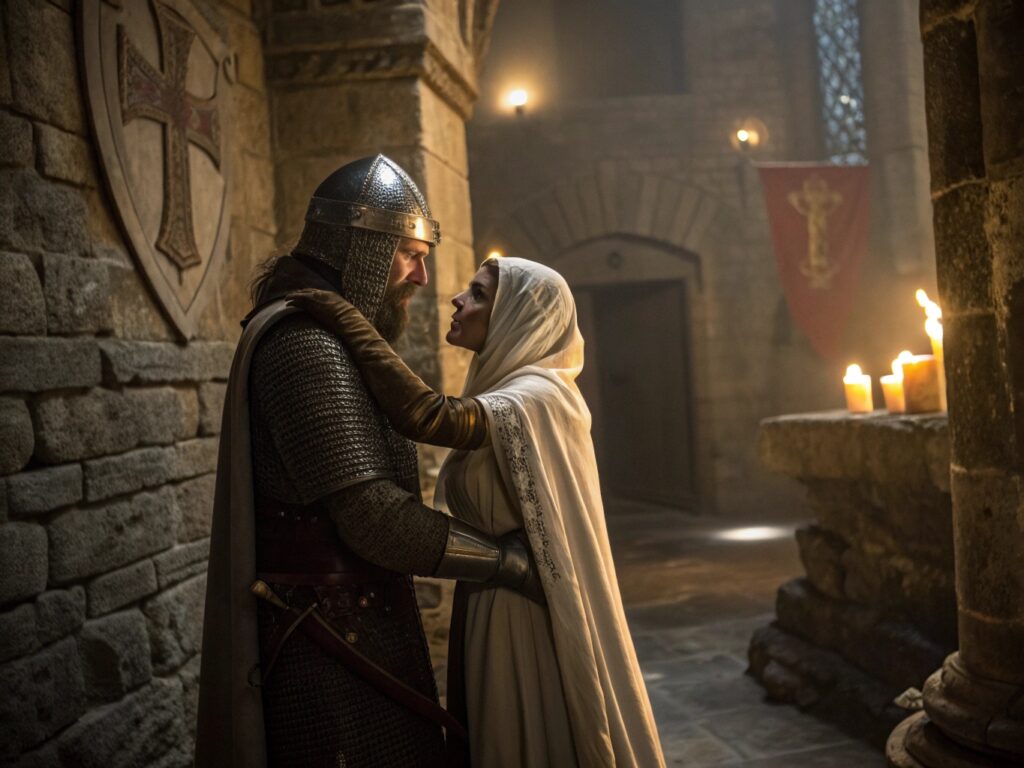
The Knights Templar are often remembered as warriors in white mantles, sworn to celibacy and obedience. According to their strict Rule, they were forbidden from marriage and family life, devoting themselves entirely to God and the protection of pilgrims. Yet whispers and legends have long circulated suggesting a different story — that behind the veil of religious duty, some Templars may have had wives and children, and even left behind secret bloodlines.
This article explores the myths, rumors, and evidence surrounding Knights Templar wives, Templar children, and the possibility of secret families of Templars hidden in the shadows of history.
The Rule of Celibacy and Obedience
The Templars were founded in 1119 under vows of poverty, chastity, and obedience. Marriage was explicitly forbidden, and any knight who broke this rule risked severe punishment or expulsion. Unlike other knights of medieval Europe who balanced duty with dynastic concerns, Templars were expected to live as monk-warriors, detached from worldly desires.
But history has shown that rules and reality often diverge. Some chronicles and later testimonies hint that not all members lived as celibate as their vows demanded.
Evidence of Forbidden Relationships
Medieval sources sometimes mention “fallen brothers” who strayed from their vows. While the official records rarely admit widespread disobedience, the vast size of the Order — stretching from the Holy Land to Scotland and Portugal — made it difficult for central authorities to enforce discipline everywhere.
It is not unthinkable that in remote commanderies, far from the eye of superiors, some Templars formed attachments with women. Such liaisons could have led to children — hidden heirs of the Temple who grew up unacknowledged by history.
The Question of Templar Children
If there were indeed Templar children, where did they go? Some historians argue they would have been quietly absorbed into local communities, raised without open acknowledgment of their father’s identity. Others believe that noble families who supported the Templars may have “covered” for these children, claiming them as distant kin.
While direct genealogical evidence is scarce, legends of Knights Templar descendants persist. Families in France, Spain, and Scotland sometimes trace their heritage to mysterious forebears tied to the Order.
The Role of Noble Women
While the Templars themselves could not marry, women played a major role in their story. Many widows and noblewomen supported the Order through donations of land and money. Some even lived on estates alongside Templar houses, working as servants, managers, or patrons.
It is within this context that rumors of Knights Templar wives appear. Though not officially sanctioned, relationships between knights and women on these estates may have blossomed in secret. Such unions, however brief, could have created family ties that survived long after the Order’s fall.
Myths of Hidden Families
The image of secret families of Templars became especially powerful after the Order was dissolved in 1312. With knights arrested, tortured, and executed, tales grew that some fled into hiding — not alone, but with wives and children in tow.
Scotland is often mentioned as a refuge where fugitive Templars allegedly merged with noble clans. Portugal, too, offered sanctuary, with the Order rebranded as the Knights of Christ. Legends suggest that in both places, Templars built lives that included families, weaving their bloodlines into local society.
The Marriage Myths
Several romanticized stories tell of high-ranking knights who secretly wed despite their vows. One of the most enduring is that of Jacques de Molay, the last Grand Master, who some claim left behind heirs. Though unsupported by documents, the myth reflects the widespread fascination with the idea of Templar marriage myths.
These tales mirror a broader human desire to imagine that such powerful figures did not simply vanish but continued through blood and family.
The Survival of Templar Descendants
In modern times, genealogical societies often claim links to the Templars. While many of these claims are unprovable, they show how the idea of Knights Templar descendants captures the imagination. To be connected by blood to a mysterious and powerful order is an alluring thought — one that has inspired novels, films, and conspiracy theories.
Even if direct biological lineage is uncertain, the cultural and symbolic “descendants” of the Templars are undeniable. Their values, legends, and myths live on, shaping how we view medieval history.
Why the Myths Persist
Why are people so fascinated with the idea of Templar wives and children? Part of the answer lies in the tension between myth and reality. A warrior-monk who renounces family is admirable, but also incomprehensible to most people. Imagining that they secretly lived as husbands and fathers makes them more human, relatable, and tragic.
Moreover, in a medieval world obsessed with lineage and inheritance, the notion that such a powerful order left no bloodline behind feels unnatural. Myths of heirs and hidden families fill that void, giving continuity to a story that officially ended in fire and suppression.
Conclusion: History and Legend Intertwined
The official record insists the Templars were celibate warriors, loyal only to God. Yet myths of Knights Templar wives, Templar children, and secret families of Templars suggest that reality may have been more complex. While hard evidence remains elusive, the persistence of these stories reveals their deeper truth: people want the Templars to live on, not just as soldiers of faith, but as fathers, husbands, and ancestors.
Whether or not the blood of the Temple truly flows through modern veins, the legends of Knights Templar descendants ensure that their story will never die.