
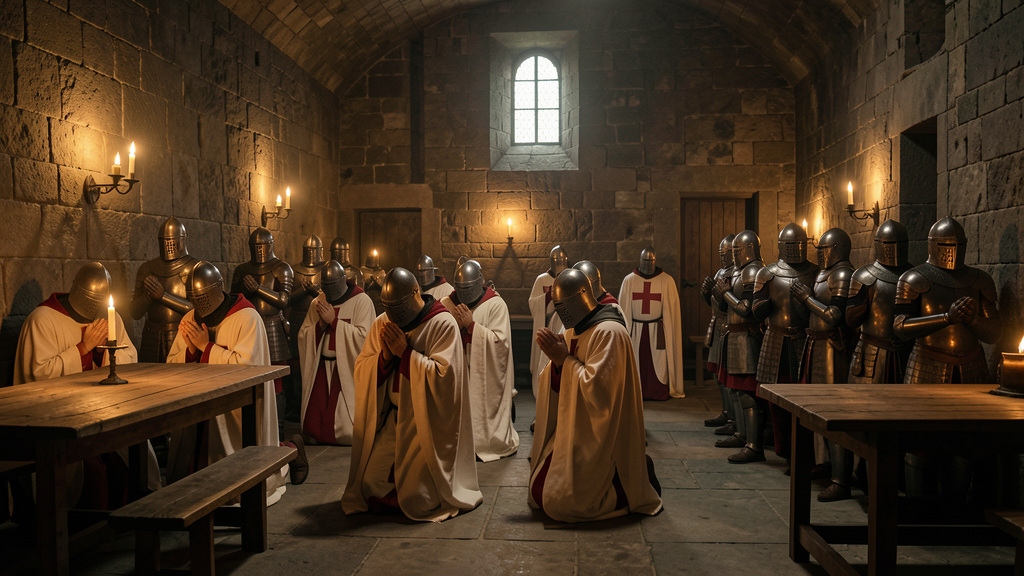
The Templar Rule: Discipline, Abstinence, and Daily Life of the Warrior Monks
On a cold morning in Jerusalem in 1129, a group of knights knelt before the Patriarch and made vows that would define their lives entirely. They were the Poor Fellow-Soldiers of Christ and the Temple of Solomon — the Knights Templar. They were not ordinary knights but warrior monks bound by a rule of life so strict that it governed every hour of every day. Central to that rule was abstinence — from luxury, from excess, from anything that weakened the body or clouded the mind. And central to their understanding was a truth now confirmed by modern medicine: the benefits of giving up alcohol and other excesses are measurable, real, and life-changing.
The Latin Rule, written in 1128 by Bernard of Clairvaux at the request of Hugues de Payens, was a revolutionary document. It contained seventy-two clauses that covered everything from how a knight should sleep to how he should conduct himself in battle. It was the first monastic rule ever written for men who would fight. And it remains one of the most detailed records we have of medieval discipline in action.
The Origins of the Templar Rule
The Knights Templar were founded in 1119 by Hugues de Payens and eight companions who committed themselves to protecting pilgrims on the dangerous roads to Jerusalem. For nearly a decade, they lived informally under the guidance of the Augustinian canons at the Church of the Holy Sepulchre. But by 1128, the order had grown large enough to need its own governing code.
Bernard of Clairvaux, the most influential churchman of his age and a cousin of one of the founding knights, took on the task. The result was the Latin Rule — a document that drew from the Rule of Saint Benedict but was adapted for men who would spend as much time on horseback as on their knees. Bernard’s De Laude Novae Militiae (In Praise of the New Knighthood) accompanied the rule and laid out the spiritual justification for a fighting monk — a concept that had seemed almost contradictory before the Templars proved it could work.
The Rule was approved at the Council of Troyes in 1129, and from that moment, every Templar knight who entered the order swore to obey it without question.
Poverty, Chastity, Obedience — and Abstinence
The three monastic vows of poverty, chastity, and obedience formed the backbone of the Templar Rule. But the Rule went far beyond these. It specified in extraordinary detail how a knight should live, and many of those specifications revolved around what we would now call health and wellness discipline.
Clothing. Templars wore simple white mantles over plain tunics. The Rule forbade fashionable pointed shoes, excessive fur trimmings, or any ornamentation. The Draper — an officer responsible for wardrobe — ensured every knight looked identical. Individuality was suppressed to reinforce humility and group identity.
Sleep. Knights slept in their shirts and breeches, with a belt and a light burning through the night. The Rule required them to sleep fully dressed so they could respond instantly to an attack. Each knight had his own narrow bed, and the dormitory was lit continuously to prevent what the Rule called “the secret deeds of darkness.”
Meals. Templars ate in complete silence. A monk read scripture aloud while the knights ate their meals, ensuring the mind was occupied with spiritual matters even during the physical act of eating. The Rule explicitly forbade gossip, laughter, and idle talk at the table. A Templar caught joking during a meal could be flogged or made to eat on the floor with the dogs.
Abstinence from alcohol. While the Templars did not completely forbid alcohol — wine was permitted in moderation, and beer was common in European commanderies — the Rule restricted it severely. Knights were not to drink to excess under any circumstances. The focus was always on maintaining clarity of mind and readiness for battle. A drunken Templar was not just embarrassing; he was a danger to his brothers and a betrayal of the order’s purpose.
The Templar Diet: Discipline at the Table
The Templar diet is one of the most fascinating aspects of their daily life, and it reflects a sophisticated understanding of how food affects the body. The Templar knight diet was carefully structured around alternating days of meat, vegetables, and fasting — a pattern strikingly similar to what modern nutritionists now recommend for metabolic health.
The Rule specified that meat could be eaten three days per week: Sunday, Tuesday, and Thursday. On Monday, Wednesday, and Friday, the knights ate vegetables, legumes, and grains — a vegetarian diet that modern research has linked to lower inflammation and better cardiovascular health. Friday was also a fish day, as was Saturday in some commanderies. During Lent and Advent, the fasting periods were even stricter, with only one meal per day and no meat at all.
This was not merely religious observance. The Templars were fighting men who needed to stay fit and healthy. Medieval food culture in the Templar era understood that overindulgence weakened a warrior. The Rule’s specific prohibition on gluttony was pragmatic. A knight who ate too much was sluggish in battle. A knight who ate too little could not swing a sword. The Templar diet struck a middle ground that kept the brothers battle-ready year-round.
Bernard of Clairvaux wrote explicitly about this: “We forbid anyone to embrace excessive abstinence; but firmly keep the communal way of life.” The Templars did not starve themselves. They practiced measured, purposeful restriction — something very different from deprivation.
The Daily Schedule: A Life Measured in Hours
A Templar knight’s day was divided into canonical hours — the eight prayer services that structured monastic life across medieval Europe. But unlike cloistered monks, the Templars had to fit military training, guard duty, and administrative work around those services.
The day began before dawn with Matins and Lauds, the night offices of prayer. After a short rest, the knights rose again for Prime at sunrise, followed by a chapter meeting where the day’s assignments were given, discipline was administered, and any rule violations from the previous day were addressed. Terce, Sext, and None — the daytime prayers — were fitted around training exercises, patrols, and administrative duties. Vespers came in the late afternoon, and the day ended with Compline before the knights retired to their dormitory, where a single lamp burned through the night.
This schedule left little time for idleness. The Templar Rule understood that idle hands led to temptation. Every hour of every day had a purpose, and the relentless structure was itself a form of discipline — training the will as surely as the sword drills trained the body.
Why Abstinence Mattered to the Templars
The Templars’ emphasis on abstinence was not about rejecting pleasure for its own sake. It was about mission readiness. A Templar knight could be called to fight at any moment. His loyalty could not be compromised by intoxication, his judgment could not be clouded by indulgence, and his body had to be capable of sustained physical exertion under extreme conditions.
This is the same logic that underlies modern medical advice about alcohol. The Templars may not have known about GABA receptors or liver enzymes, but they understood intuitively that alcohol impairs judgment, weakens physical performance, and creates dependency. They structured their lives to minimize those risks — not out of prudishness, but out of strategic necessity.
The parallels are striking. When someone gives up alcohol today, the benefits emerge on a clear timeline. In the first week, sleep improves dramatically, as alcohol’s disruption of REM sleep cycles ceases. By week two, hydration normalizes, and the gut begins healing from inflammation. By week three, blood pressure drops. By the end of the first month, liver inflammation has measurably decreased. The Templars could not measure these changes, but they lived them. Their bodies were stronger, their minds sharper, their endurance greater — all because they practiced the same abstinence that modern recovery programs recommend.
And the Templars took it further. Their Rule forbade gambling, hunting, games, and even excessive laughter. All of these, in their view, distracted a man from his purpose. The modern parallel is the understanding that addiction is not only about substances — it is about the patterns and behaviors that accompany them.
Punishment and Restoration
The Templar Rule had a detailed system of punishments for infractions. A knight who broke the Rule was not simply expelled; he was given a path back to discipline — just as modern recovery programs offer structured paths back to sobriety.
Minor infractions earned a flogging or a period of eating meals on the floor with the dogs. More serious violations — theft, desertion, revealing the order’s secrets — resulted in expulsion. But the most interesting punishment from a modern perspective was the loss of the knight’s habit — his white mantle. To lose the mantle was to lose one’s identity as a Templar temporarily. The knight had to earn it back through demonstrated discipline, just as someone in recovery must rebuild trust and demonstrate commitment over time.
Life in a Templar commandery was demanding, and the disciplinary structure ensured that every knight knew the consequences of failure. But the system was designed for restoration, not destruction. The goal was always to bring the knight back to full capability.
The Physical Benefits of the Templar Way
Modern archaeologists and historians have noted that Templar skeletons often show signs of remarkable physical health compared to the general medieval population. Their bones show less evidence of the joint diseases and nutritional deficiencies common among peasants and even other knights. The combination of a balanced diet, regular physical training, structured fasting, and abstinence from alcohol produced measurable health benefits — the same benefits that modern medicine now quantifies in people who adopt similar practices.
A Templar in the Holy Land enjoyed figs, almonds, pomegranates, olives, and fresh fish alongside his beans and grains. This was not a deprivation diet. It was a diet that provided complete nutrition while avoiding the inflammatory effects of excessive meat, alcohol, and sugar that plagued the medieval upper classes. The Rule even specified that sick or elderly knights should receive more food and better cuts, showing a practical understanding that health needs varied by individual — a principle that seems surprisingly modern.
What the Templar Rule Teaches Us Today
The Templar Rule of Life was not written for our time, but its principles have a surprising resonance. The knights understood that discipline — consistent, daily, structured discipline — was the foundation of any meaningful change. They knew that abstinence from harmful substances was not a punishment but a liberation. They knew that a structured daily routine created space for what mattered. And they knew that the body and mind were connected — that what you put into your body determined what you could get out of your mind.
The Templars did not have clinical studies or blood panels. They had eight centuries of lived experience, refined through a Rule that governed every waking hour. And that experience told them the same thing that modern science now confirms: giving up alcohol changes your life. Better sleep. Lower blood pressure. Clearer thinking. Restored relationships. Reduced inflammation. Measurable improvements within weeks.
Bernard of Clairvaux wrote the Rule for warriors who needed to be ready. Eight hundred years later, the same principles apply to anyone ready to make a change.