
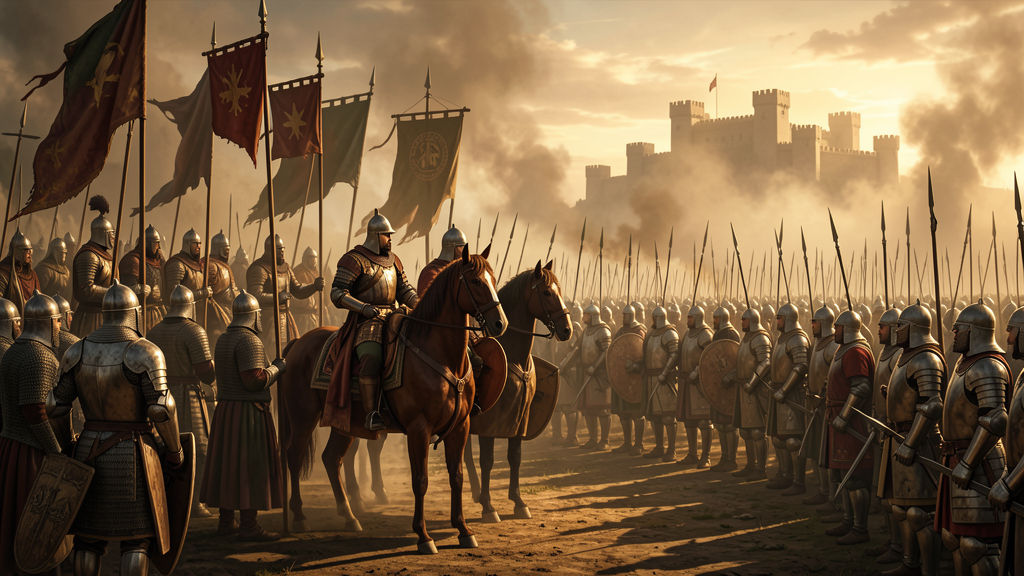
A medieval army could look magnificent from a distance: banners lifting in the wind, mail glinting, horses stamping, priests murmuring prayers before the line moved. Up close, it was much messier. Thousands of armed people had to eat, march, camp, keep formation, recognize signals, obey unfamiliar lords, and somehow avoid trampling their own allies when the shouting began.
That is why the medieval army command structure mattered so much. Victory rarely came from bravery alone. It depended on who could gather men, keep them supplied, place them in the right part of the field, and make orders travel across dust, fear, and noise.
The surprising part is that medieval armies did not use one neat, universal ranking system. A French host in the Hundred Years’ War, a Norman expeditionary army, an English royal force, a crusading army in the Levant, and the Knights Templar all organized command in different ways. Still, several patterns appear again and again: supreme command at the top, noble and household leaders beneath it, specialist officers handling discipline and movement, and practical authority often resting with the people who knew how to keep men alive on campaign.
The First Rule: Medieval Rank Was Personal, Not Bureaucratic
Modern readers expect ranks to be fixed. A captain is above a lieutenant. A colonel is above a major. Medieval war did not work so cleanly. Titles existed, but authority came from several overlapping sources: landholding, noble birth, royal appointment, military reputation, money, contract, household service, and religious office.
A great lord could bring hundreds of men because he owned land and had vassals. A household knight could command respect because he served close to a king. A veteran sergeant might have less social prestige than a young noble, yet know far more about keeping a line steady under arrows. In a crusading army, a military order such as the Templars might obey its own master and marshal while still cooperating with kings, princes, and local barons.
So when we speak about medieval military ranks, we should not imagine a laminated chart. We should imagine a web of obligations. Men followed banners, family names, contracts, paymasters, religious superiors, and commanders whose reputations had been tested in previous campaigns.
Supreme Command: The King, Prince, or Great Lord
At the top stood the ruler or magnate who called the army into being. In theory, this person held supreme command. A king could summon feudal levies, hire mercenaries, appoint officers, choose a route, decide whether to seek battle, and negotiate surrender or ransom. A duke, count, or crusading prince could perform the same role on a smaller scale.
In practice, supreme command was often political as much as military. A king had to keep powerful nobles from quarrelling, decide who received the honor of leading the vanguard, and balance military sense against prestige. In crusading armies, the problem could be even worse. Princes from different regions might share the same religious goal but disagree over strategy, loot, castles, and precedence.
This explains why medieval battles could swing on questions that look petty from the outside. Who had the right to command the front line? Whose banner stood nearest the ruler? Who could give orders to troops supplied by another lord? These were not ceremonial details. They determined who moved first, who took losses first, and who claimed victory afterward.
Constables and Marshals: The Officers Who Made Armies Move
Below the ruler were senior officers whose titles varied by kingdom and century. Two of the most important were the constable and the marshal. These offices had roots in household management, especially horses and royal service, but by the later Middle Ages they could carry serious military authority.
In France and England, command during the Hundred Years’ War was often delegated to chief military officers, especially constables and marshals. WarHistory’s overview of command of medieval armies notes that the long duration and wide geography of the conflict made delegation unavoidable. A king could not personally direct every march, siege, garrison, raid, and negotiation.
The marshal’s responsibilities could include arranging the order of march, overseeing camp discipline, managing horses, organizing the battle line, and enforcing decisions made by the high command. The constable might exercise broader royal military authority, especially when the king was absent, ill, young, or politically constrained.
This is one of the best openings for a new article because it answers a question searchers often have: not just “what were medieval army ranks?” but “who actually gave orders?” The answer is rarely one person. A campaign might be proclaimed by a king, shaped by council, organized by marshals, led locally by nobles, and kept functional by captains, sergeants, clerks, scouts, farriers, cooks, and wagon drivers.
Nobles, Bannerets, and Household Knights
The noble command layer formed the visible heart of many medieval armies. Lords brought their own retinues: knights, squires, men-at-arms, archers, servants, and specialists. These groups often fought near the lord’s banner, which served as a rallying point in the confusion of battle.
A knight banneret, in broad terms, was a knight entitled to lead men beneath his own banner rather than serving merely under another’s. Not every region used the title in exactly the same way, but the principle was common: some knights were independent military leaders, while others served in households or companies under greater men.
Household knights were especially valuable. They were not simply romantic figures in polished armor. They were professional armed retainers attached to a lord’s court, often trusted with missions, garrison duties, escort work, and battlefield command. In a world where written orders moved slowly and loyalty was personal, the lord’s household could be more dependable than a temporary levy.
This is also where social rank and battlefield usefulness could clash. A young noble might expect honor because of birth. An older household knight might be the person other men watched when the line wavered. Medieval command always had this tension: status mattered, but so did competence.
Captains, Sergeants, Men-at-Arms, and Infantry Leaders
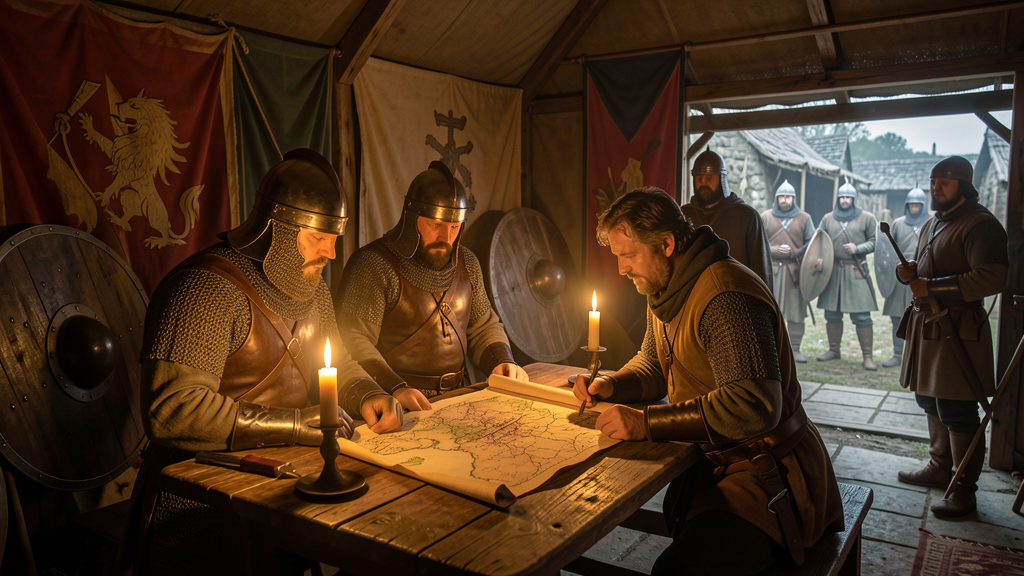
Beneath the aristocratic command layer were the people who made smaller units work. The word “captain” becomes more prominent in later medieval warfare, especially as paid companies, garrisons, and contracted forces grew in importance. A captain might command archers, crossbowmen, infantry, mounted men-at-arms, or a mixed company.
Sergeants are easy to misunderstand. In many medieval contexts, a sergeant was not the same as a modern non-commissioned officer. The term could describe a professional fighting man below knightly status, sometimes mounted, sometimes infantry, sometimes connected with administrative or guard duties. In the military orders, sergeants formed a recognized class below knights but above many servants and laborers.
Men-at-arms were armored fighting men, often mounted but not always knights. By the later Middle Ages, this category could include nobles, knights, squires, and professional soldiers equipped for heavy combat. Infantry leaders, meanwhile, could be drawn from towns, militias, mercenary bands, or experienced local fighters. Crossbowmen from Italian cities, Flemish infantry, Welsh archers, and Swiss pikemen all remind us that medieval war was never just mounted knights thundering across a field.
For readers already interested in the broader medieval army structure, this distinction matters. A “rank” on paper does not tell the whole story. Equipment, pay, training, origin, and battlefield role could matter just as much.
How Orders Moved Across the Field
Even the best commander faced a brutal technical problem: how do you communicate once battle begins?
There were no radios, no staff cars, no satellite maps. Orders moved through messengers, heralds, trumpets, drums, shouted commands, visible banners, prearranged formations, and the example of leaders moving in front of their men. Banners were not decorative. They told soldiers where their lord stood, where to rally, and whether a section of the line was advancing or breaking.
This made medieval command highly visual. A commander had to be seen. If a banner fell, men might panic. If a rumor spread that the king had died, a retreat could become a rout. If a messenger was killed or delayed, one wing of the army might attack while another held back. Battle plans had to be simple enough to survive confusion.
Sieges created different command problems. A siege required guard rotations, digging, carpentry, stone-throwing engines, mining, negotiations, supply management, disease control, and discipline over weeks or months. The knight who shone in a charge might be less useful than a patient engineer, a careful quartermaster, or a commander who could stop bored troops from deserting.
The Forgotten Command Problem: Moving the Army Before Battle
Medieval armies spent far more time marching, camping, and foraging than fighting. That meant command was often logistical before it was heroic. Someone had to decide the route. Someone had to keep wagons from clogging roads. Someone had to find water, fodder, and food. Someone had to stop soldiers from scattering too widely in search of supplies.
This is the unglamorous side of war, but it is where many campaigns were won or lost. A hungry army slowed down. A disorderly baggage train invited attack. Horses needed enormous amounts of fodder. Armor, tents, weapons, mills, cooking gear, arrows, spare shoes, and siege tools all had to move with the force or be found along the way.
The comparison is not exact, but the basic challenge is still recognizable: large movements fail when planning, timing, and trustworthy carriers break down. Even a peaceful household relocation is easier when people can compare long-distance movers, estimate costs, and coordinate the route before anything heavy starts moving. A medieval commander faced the same logic under harsher conditions: the farther the journey, the more damaging every small failure became.
Why the Templars Had a Cleaner Chain of Command
The Knights Templar make a useful contrast with ordinary feudal armies. Founded around 1119 and given papal recognition in 1129, the order combined monastic discipline with military service. World History Encyclopedia summarizes the Templars as a Catholic military order whose members defended Christian holy sites and pilgrims while becoming an elite part of crusader armies.
That religious structure gave the Templars a clearer internal hierarchy than many secular hosts. The master of the order stood at the top, supported by senior officers such as the seneschal, marshal, commanders, knights, sergeants, chaplains, and serving brothers. The exact responsibilities shifted over time and place, but the principle was consistent: the order expected obedience because it was not merely a military association. It was a vowed community.
This did not mean the Templars operated in isolation. On crusade, they still had to coordinate with kings, nobles, bishops, Hospitallers, local rulers, and allied forces. But within their own ranks, obedience could be stricter than in a coalition of jealous lords. A Templar knight was not just following a battlefield superior. He was following a religious rule, a corporate chain of command, and a life he had sworn to obey.
That difference helps explain why posts on Templar ranks should be treated separately from general medieval army ranks. The Templars belonged to the medieval world, but their command system was more institutional than most feudal warbands.
A Simple Medieval Army Ranks in Order Snapshot
No single chart fits every kingdom, but a simplified campaign hierarchy might look like this:
- King, prince, duke, count, or crusade leader: supreme political and military authority.
- Constable or marshal: senior officer responsible for delegated command, order, discipline, movement, or battle arrangement.
- Great nobles and bannerets: leaders of retinues who fought under their own banners.
- Household knights and captains: trusted professional commanders of smaller groups.
- Men-at-arms, knights, and squires: armored combatants serving in heavy cavalry or dismounted roles.
- Sergeants: professional fighters or support personnel, depending on region and institution.
- Archers, crossbowmen, spearmen, militia, and levies: infantry and missile troops organized by town, lord, contract, or campaign need.
- Noncombatant specialists: clerks, priests, surgeons, farriers, engineers, wagoners, cooks, servants, and laborers who kept the army alive.
The final group is often left out of popular medieval war stories, but no army could survive without it. Medieval command did not end at the noble tent. It reached into the smithy, stable, chapel, kitchen, wagon line, and ditch outside a besieged wall.
Why Medieval Command Broke Down
Medieval commanders failed for reasons that were often structural. Armies were temporary coalitions. Soldiers came from different regions and spoke different dialects. Nobles protected their honor. Pay could arrive late. Feudal service might expire after a fixed period. Mercenaries could change employers. Weather ruined roads. Disease thinned camps. Horses died.
On the battlefield, the problems multiplied. A cavalry charge could become uncontrollable once launched. Infantry might refuse to advance if abandoned by mounted elites. Archers could run short of arrows. A flank might not see the signal. A commander might be captured, killed, or simply unable to make himself heard.
This is why experienced leaders often valued discipline over spectacle. The army that held formation, guarded its supplies, obeyed signals, and retreated in order had advantages that did not look glamorous in a chronicle. The best medieval command was not always the loudest or noblest. Often it was the command that kept men from doing the foolish thing five minutes too early.
Questions Readers Often Ask
What was the highest rank in a medieval army?
The highest authority was usually the king, prince, duke, count, or crusade leader who summoned and financed the army. In practice, that authority was often delegated to senior officers such as constables, marshals, or trusted nobles, especially during long campaigns.
Did medieval armies have captains?
Yes, especially in later medieval warfare. Captains could command companies, garrisons, archers, mercenaries, or men-at-arms. The title did not always mean the same thing in every region, but it became increasingly important as paid military service expanded.
Were knights always commanders?
No. Knights had high social and military status, but not every knight commanded large numbers of men. Some served as household retainers, elite fighters, escorts, or members of a lord’s retinue. Command depended on wealth, trust, experience, and the number of followers a knight could bring.
How were the Templars different from ordinary crusaders?
Ordinary crusaders might serve under a prince, lord, or temporary vow. Templars belonged to a permanent military order with its own rule, hierarchy, property, officers, and religious obligations. That made their internal command structure more disciplined than many feudal forces.
The Real Chain of Command Was Human
The medieval army command structure was never just a ladder from king to knight to peasant. It was a living arrangement of power, loyalty, fear, faith, money, and practical skill. A ruler might declare war, but marshals made armies move. Nobles brought retinues, but captains kept companies together. Banners showed men where to rally, but trust decided whether they stayed.
That is what makes medieval command so fascinating. It stood halfway between household politics and professional war. It could produce astonishing courage and disastrous confusion in the same afternoon. Behind every charge of armored knights was a quieter question that decided the fate of campaigns: who, exactly, was being obeyed?