
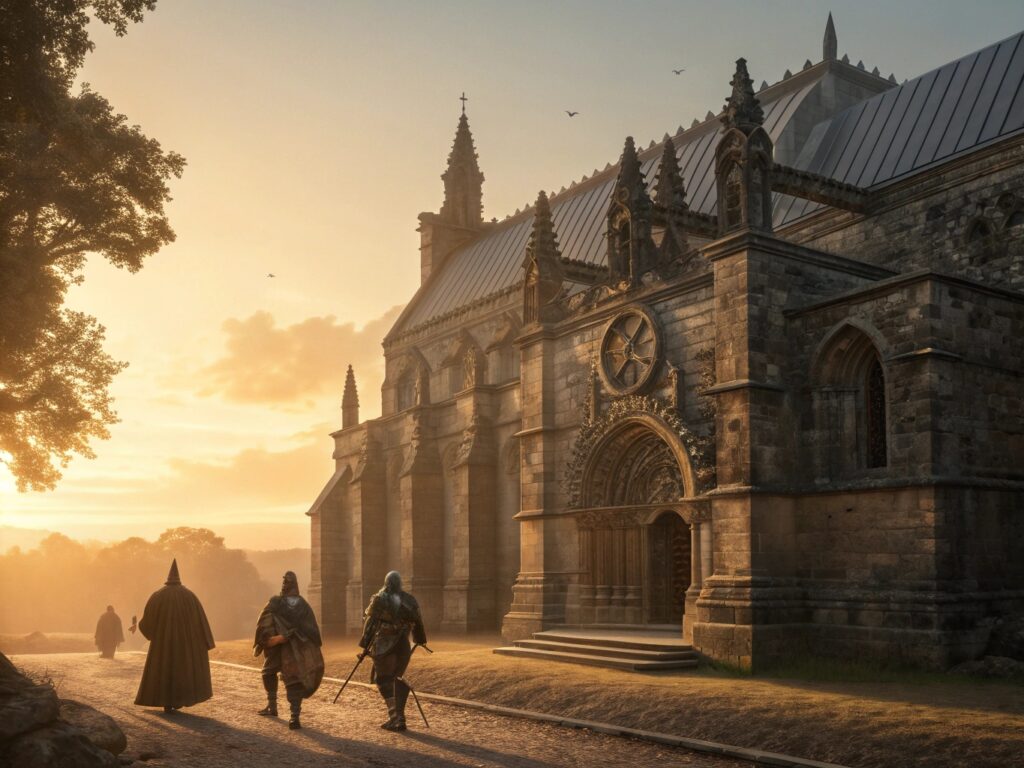
The Knights Templar remain one of the most mysterious and influential orders in medieval history. Formed in the early 12th century to protect pilgrims in the Holy Land, they quickly grew into a military and financial powerhouse. But beyond their martial reputation, an enduring question persists: Did the Knights Templar have bloodlines and dynastic ambitions, or did they truly live as celibate warriors of God?
In this article, we’ll explore the myths, legends, and historical realities surrounding the Knights Templar bloodlines, the idea of Templar descendants, and how the legacy of the Order may have stretched far beyond the battlefield.
The Official Rule of the Order
When Hugues de Payens and his companions established the Order in 1119, they pledged vows of poverty, chastity, and obedience. The Templar Rule, approved at the Council of Troyes in 1129, made it clear: members were forbidden from marrying or producing heirs. Unlike other knights of their era, who were deeply tied to land and family legacy, Templars were expected to devote themselves wholly to God and the mission of the Order.
Yet, history is rarely so clear-cut. Despite strict rules, whispers of Templar descendants have persisted through the centuries.
Noble Families and the Rise of the Templars
The Templars were not born in isolation. They drew their strength from the noble families of France, England, Spain, and beyond. Many young men who joined the Order came from dynasties that had been warriors for generations.
These families often donated land, castles, or wealth to the Templars, binding themselves to the fate of the Order. In this sense, even if individual knights had no heirs, the Templar family legacy lived on through their brothers, sisters, and extended kin who benefitted from or supported the Order.
It is no coincidence that some of the most powerful European dynasties are rumored to have maintained Templar connections. In Portugal, Scotland, and parts of France, the legend of Knights Templar bloodlines remains deeply woven into local folklore.
Secret Marriages and Hidden Children?
One of the most controversial claims is that some Templars may have secretly taken wives or fathered children. Officially, such actions would have been punishable by expulsion. Yet, the Templars were spread across thousands of commanderies, often in remote areas where papal oversight was thin.
Medieval chronicles occasionally hint at “fallen brothers” who strayed from the vows. Later legends even describe entire lineages said to descend from high-ranking Templars who bent the rules for the sake of dynastic survival.
While hard evidence is scarce, these tales fuel the fascination with Templar genealogy myths. They suggest that behind the façade of strict discipline, some knights may have balanced duty with family life.
The Sinclair Legend and the Scottish Connection
Few stories of Templar descendants are as compelling as those surrounding the Sinclair family of Scotland. According to local tradition, the Sinclairs sheltered fugitive Templars after the Order’s dissolution in 1307. The construction of Rosslyn Chapel in the 15th century is often linked with alleged Templar symbolism, reinforcing the belief that the family carried on the dynastic Knights Templar heritage.
Though historians debate the truth of these claims, they highlight how the myth of Templar families shaped national identity and legend.
Portugal: A Safe Haven for the Order
While most of Europe saw the Templars suppressed, King Denis of Portugal offered them protection. He rebranded the Order as the Knights of Christ, effectively allowing them to continue under a new name. Some argue this continuity enabled the survival of Templar traditions—and perhaps even Templar bloodlines—within Portuguese noble families.
Centuries later, explorers like Vasco da Gama and Henry the Navigator drew upon the resources and symbolism of the Knights of Christ, suggesting that the Templar family legacy remained alive, if not genetically, then institutionally.
Why Bloodlines Mattered in Medieval Culture
To medieval people, the concept of bloodline was everything. Nobility was defined not just by wealth or land, but by lineage. It is no wonder, then, that rumors of Templar descendants emerged. A military order that held immense land and treasure but left no heirs would have seemed unnatural.
For rival dynasties, claiming ties to the Templars was a way to legitimize power. For later generations, it offered a link to a chivalric, mysterious past. The persistence of Templar genealogy myths shows how compelling the idea of bloodlines was in shaping history.
The Fall of the Templars and the Fate of Families
When the Templars were dissolved in 1312 by Pope Clement V, many knights were arrested, tortured, or executed. Their lands were confiscated, and their name was shrouded in scandal.
But what of their families? Historical records show that many noble kin of Templars fought fiercely to retain their donations or reclaim property. In some cases, estates passed back into family hands. Thus, while the Order was extinguished, its impact on medieval dynasties continued for centuries.
Modern Families Claiming Templar Descent
Even today, families in Scotland, Portugal, France, and Italy claim to be direct Templar descendants. Genealogical societies trace alleged bloodlines, sometimes linking modern names to medieval knights.
Skeptics argue that most of these claims are inventions, born of the romantic 19th-century fascination with chivalry. Yet the persistence of these stories underscores the enduring allure of the dynastic Knights Templar.
Whether fact or fiction, they keep alive the dream that somewhere, the blood of the warrior-monks still flows through modern veins.
Conclusion: History, Myth, and Legacy
Were the Knights Templar truly dynastic? Officially, no. Their vows of chastity and obedience left no room for heirs. But history is more than official rules. Through noble family ties, legends of hidden children, and claims of surviving lineages, the idea of Knights Templar bloodlines remains powerful.
Fact and myth blend seamlessly in this story, reminding us that the legacy of the Templars was never just about swords and fortresses. It was also about families, bloodlines, and the enduring human need to connect to a noble past.