
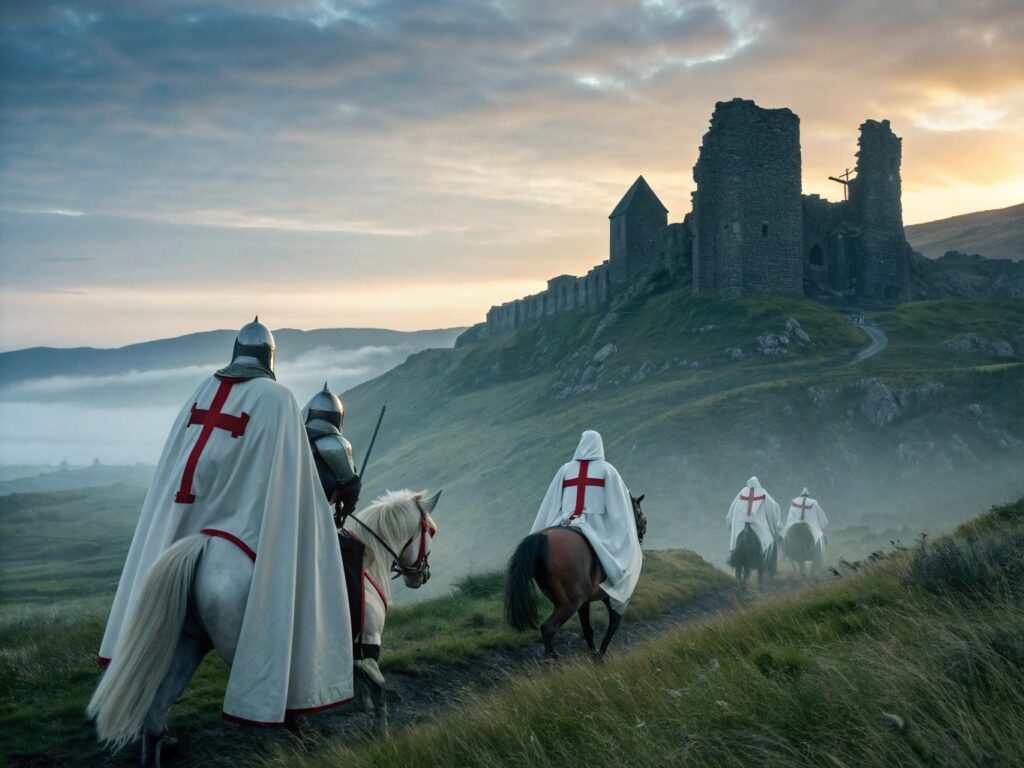
The Knights Templar bloodline has fascinated historians, writers, and seekers of hidden truths for centuries. After the Fall of the Templars in the early 14th century, when the order was persecuted by kings and condemned by the church, rumors spread that some knights escaped with not only treasure but also sacred bloodlines. From Scotland Templar legends to claims of Templar influence in Portugal’s history, myths about Templar descendants continue to spark curiosity.
But what lies behind the stories of the Templar bloodline myths? Are they evidence of survival, family legacy, and hidden genealogies, or simply the invention of later imagination? This article traces the path of these myths from the Scottish Highlands to the Portuguese coast, uncovering what they meant for medieval survival and modern fascination.
The Templar Lineage Question
When the order was dissolved in 1312, the knights were accused of heresy, their leaders executed, and their lands confiscated. Yet the question remained: did the Templar bloodline survive?
Most Templars were celibate as members of a religious order. However, before joining, many came from noble families, bringing with them connections, kinship ties, and potential heirs. Templar lineage thus refers not only to direct descendants but also to surviving families who carried on traditions, legends, and influence.
Scotland: The Refuge of the Templars
One of the strongest Scotland Templar legends holds that knights fleeing persecution found refuge in the Highlands. Local folklore connects the Templars to the Battle of Bannockburn in 1314, where Robert the Bruce defeated the English. Some accounts claim mysterious warriors appeared on the battlefield—identified as fugitive Templars lending their strength to Scotland’s cause.
Scottish Clans and Templar Roots
Certain Scottish clans have claimed Templar roots, suggesting that knights integrated into local society through bloodlines and marriage. These connections are often wrapped in folklore rather than verifiable genealogy, but the idea of Templar descendants in Scotland adds a sense of continuity and mystery.
Influence on Freemasonry
Scotland is also central to the theory that Templars inspired Freemasonry. Lodges in the 18th century frequently referred to Templar symbols and legends, reinforcing the belief that secret Templar genealogy survived in Scottish brotherhoods.
Portugal: The Order of Christ and Templar Legacy
If Scotland preserved Templar myths, Portugal preserved Templar structures. King Dinis of Portugal cleverly avoided conflict with the papacy by transforming the remnants of the order into the Order of Christ in 1319.
Templar Descendants Portugal
Many historians argue that Portugal offered the clearest survival route for Templars and their families. Former knights, estates, and traditions were absorbed into this new order, ensuring continuity of both bloodlines and influence. For descendants, this meant protection under royal patronage rather than persecution.
Influence on Exploration
The Order of Christ later played a crucial role in financing voyages during the Age of Discovery. From Henry the Navigator onward, Portuguese explorers carried not only sails but also Templar symbols. Myths claim that Templar bloodline legends extended into these ventures, with families connected to the order guiding Portugal’s rise as a seafaring empire.
Myths of Hidden Descendants
Across Europe, stories of hidden Templar descendants circulated for centuries. These legends often centered on:
-
Secret marriages: Tales that Templars who escaped persecution quietly married into noble houses, blending bloodlines with existing dynasties.
-
Sacred relics: Some myths link Templar families to guardianship of relics, such as the Holy Grail or ancient manuscripts.
-
Disguised heirs: In regions like France and Spain, stories claim children of Templars were hidden under new surnames to escape the Inquisition.
Though difficult to verify, such stories fueled the idea of Templar survival myths that stretched across generations.
Portugal vs. Scotland: Two Paths of Legacy
Comparing the two regions reveals different faces of the Templar legacy in Europe:
-
In Scotland, survival was mythic, tied to battles, secret brotherhoods, and clan genealogies.
-
In Portugal, survival was institutional, channeled through the Order of Christ, which kept much of the Templar wealth, land, and influence intact.
Together, these regions embody the dual nature of the Knights Templar bloodline legends—half history, half myth.
The Appeal of Templar Bloodline Myths
Why do Templar family secrets and bloodline legends still captivate us today? Several reasons stand out:
-
Romance of the Lost Order: The sudden suppression of the Templars invites speculation about what was hidden or preserved.
-
Connection to Power: Bloodline myths tie the Templars to noble families, suggesting hidden influence in later centuries.
-
Mystery of Survival: From Scottish myths to Portuguese survival, these stories offer hope that something endured against persecution.
-
Link to Freemasonry: The symbolic inheritance of Templar imagery in later societies keeps the connection alive.
Bloodline and the Grail Connection
No discussion of Templar myths would be complete without the Holy Grail. Popularized in modern literature, the Grail is often tied to the idea of a sacred Templar bloodline—sometimes even linked to the descendants of Christ himself. While historically unsupported, these ideas blend with Scottish and Portuguese myths to deepen the aura of mystery.
The Grail myth reframes the Templars not only as warriors but as guardians of hidden truth, passing it down through families and secret societies.
Historical Skepticism vs. Folklore
Historians remain cautious about claims of direct Templar lineage. Records show the order was dissolved, and most members faced trials, exile, or integration into other institutions. Yet, folklore thrives where records fall silent.
-
In Scotland, the lack of papal enforcement left room for imagination.
-
In Portugal, the seamless continuation into the Order of Christ blurred lines between myth and reality.
Thus, while literal Templar bloodline survival is uncertain, the symbolic power of these myths has proven remarkably enduring.
Conclusion: Between History and Legend
From Scotland to Portugal, the myths of the Templar bloodline weave together history, folklore, and imagination. In Scotland, stories of secret heirs and battlefield appearances fuel legends of resistance and hidden genealogy. In Portugal, the continuity of the Order of Christ preserved both influence and memory, ensuring that the Templar descendants were not forgotten.
Whether or not the bloodline truly survived, these myths remind us of humanity’s need to believe in endurance, legacy, and secret survival against impossible odds. The Knights Templar bloodline may remain a mystery, but it continues to shape how we imagine history itself.