
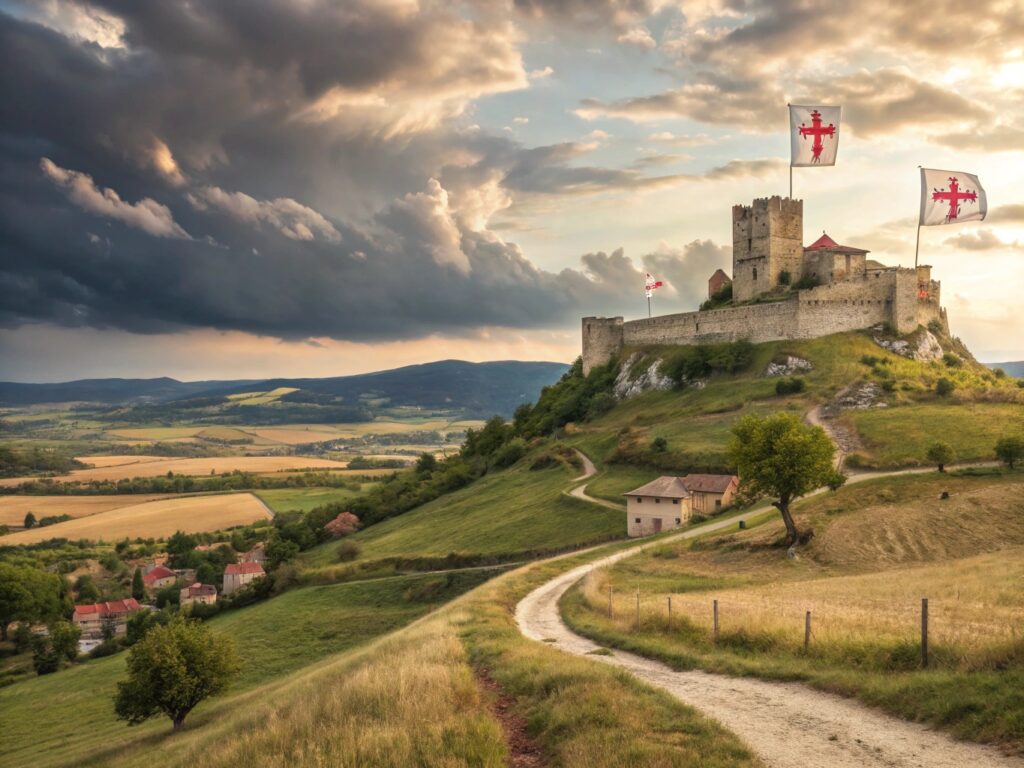
The Knights Templar are often remembered as fierce warriors and guardians of the Holy Land. Yet behind the battlefield stood a vast network of Templar family estates—castles, farms, and manors that supported their order and shaped medieval society. These estates provided wealth, food, shelter, and security for not only the knights but also their relatives, tenants, and dependents.
The Templar castles and farms scattered across Europe became symbols of their power. But when persecution struck in the early 14th century, questions of confiscation, inheritance, and hidden treasures emerged. What happened to these lands, and what legends of secret wealth still haunt their ruins?
The Foundations of Templar Estates
From their origins in the 12th century, the Templars accumulated property through donations, royal patronage, and strategic acquisitions. Noble families eager to gain spiritual merit often donated land, creating the backbone of Templar estates in Europe.
These holdings were not simply symbols of wealth. They functioned as:
-
Administrative centers for managing finances and logistics.
-
Training grounds where recruits learned discipline and combat.
-
Support systems for pilgrims and travelers.
-
Sources of food and income through farms, mills, and vineyards.
By the 13th century, the Templars had built a network of Templar strongholds, stretching from France and England to Spain, Portugal, and beyond.
Templar Castles: Strongholds of Power
Few symbols are as enduring as the Templar castles. These fortresses were both military and residential, protecting knights, storing resources, and safeguarding relics.
Notable Templar Castles in Europe
-
Tomar Castle (Portugal): Perhaps the most famous, it later became the seat of the Order of Christ, preserving Templar traditions after suppression.
-
Château de Gisors (France): Associated with both administrative power and legends of treasure hidden in its underground tunnels.
-
Castle of Ponferrada (Spain): A massive fortress strategically located along pilgrimage routes to Santiago de Compostela.
-
Temple Church in London: While not a castle, this iconic structure reveals the order’s architectural influence in England.
These castles were often surrounded by Templar manors and villages, forming communities bound by labor, faith, and loyalty.
Templar Farms: Engines of Survival
Beyond the grandeur of castles, Templar farms provided the backbone of daily life. The order excelled at managing agricultural estates, ensuring self-sufficiency and financial independence.
Life on Templar Farms
-
Crops and Vineyards: Estates cultivated wheat, barley, grapes, and olives.
-
Livestock: Sheep and cattle supported food supplies and trade in wool.
-
Mills and Bakeries: Many estates operated watermills and ovens, serving both knights and locals.
-
Peasant Tenants: Local families worked the land, often finding stability under Templar administration compared to feudal lords.
The Templar agricultural estates were not only productive but also innovative. Their wealth rested not just in battle spoils but in carefully managed fields.
Family Connections to Estates
Though the knights themselves followed vows of celibacy, their broader kinship networks benefited from Templar wealth. Templar family estates often provided homes for relatives, safe havens for widows, or dowries for daughters. Donations of land sometimes came with the expectation that relatives would be protected under Templar patronage.
When the Knights Templar estates were confiscated in the early 14th century, families tied to the order often suffered displacement. Lands were transferred to the Hospitallers or seized by the crown, leaving tenants at the mercy of new landlords.
Confiscation and Redistribution of Estates
The Fall of the Templars in 1307 brought turmoil to their estates. King Philip IV of France, heavily in debt to the order, moved swiftly to confiscate their properties.
-
France: Estates were seized, and much of the land absorbed by the crown or passed to the Hospitallers.
-
England: The crown hesitated, leading to a slower and more partial transfer of lands.
-
Portugal: The estates were preserved by transforming the Templars into the Order of Christ, safeguarding their farms and castles under new names.
The redistribution marked the end of the Templar land holdings, but not the end of their legends.
Hidden Treasures: Fact or Folklore?
No aspect of Templar estates inspires more fascination than the idea of Templar hidden treasures. From gold and relics to secret documents, countless stories claim the Templars concealed wealth within their castles and farms before persecution.
Legends of Templar Treasure
-
Gisors (France): Legends suggest that treasure was buried in underground vaults beneath the castle.
-
Paris Temple: Some say treasure disappeared from the Paris headquarters just before the arrests in 1307.
-
Scotland: Myths claim that fleeing knights carried treasures north, later tied to Freemasonry.
While little physical evidence has surfaced, these myths persist because the Templars’ sudden downfall leaves many unanswered questions. Did they truly hide gold and relics, or is the real treasure their enduring influence?
Everyday Life on Templar Estates
It is easy to focus only on knights and treasures, but everyday life on Templar lands reveals a deeper story.
-
Families: Relatives of knights, tenant farmers, and servants lived in villages around castles and farms.
-
Faith: Chapels and churches dotted the estates, providing spiritual life.
-
Trade: Surplus goods from farms were traded, linking Templar estates to medieval markets.
In many ways, the Templars were as much landlords as warriors. Their estates shaped the rhythms of medieval society long before persecution erased their presence.
Templar Estates in Portugal: A Lasting Legacy
Unlike other regions, Portugal preserved the essence of Templar estates through the Order of Christ. Castles like Tomar and farms across the country continued to operate, ensuring continuity.
This survival had far-reaching consequences. By the 15th century, Portuguese explorers, backed by the Order of Christ, set sail on voyages that reshaped global history. The Templar legacy in Portugal thus extended from medieval farms to the Age of Discovery.
Why Templar Estates Still Fascinate
The enduring fascination with Templar castles, farms, and hidden treasures arises from their dual nature: part history, part legend.
-
They symbolize power and resilience in the Middle Ages.
-
Their sudden confiscation raises questions of loss and injustice.
-
Their rumored treasures feed the imagination of treasure hunters and storytellers.
-
Their preservation in Portugal links them directly to later global exploration.
For historians and enthusiasts alike, the estates are the foundation of both Templar wealth and myth.
Conclusion: Stones, Soil, and Secrets
The Templar family estates were more than castles and farms—they were communities, livelihoods, and symbols of stability. Their Templar castles stood as fortresses of faith, while their Templar farms sustained armies and families alike.
When persecution struck, much was lost. Yet the myths of Templar hidden treasures, secret vaults, and family survival endure. Whether preserved through the Order of Christ in Portugal or remembered in legends of France and Scotland, these estates remind us that the Templars’ power was built not only on swords but also on stones and soil.
In the end, the true treasure of the Templars may not lie in buried gold but in the enduring fascination their estates inspire—a legacy of faith, resilience, and mystery.