
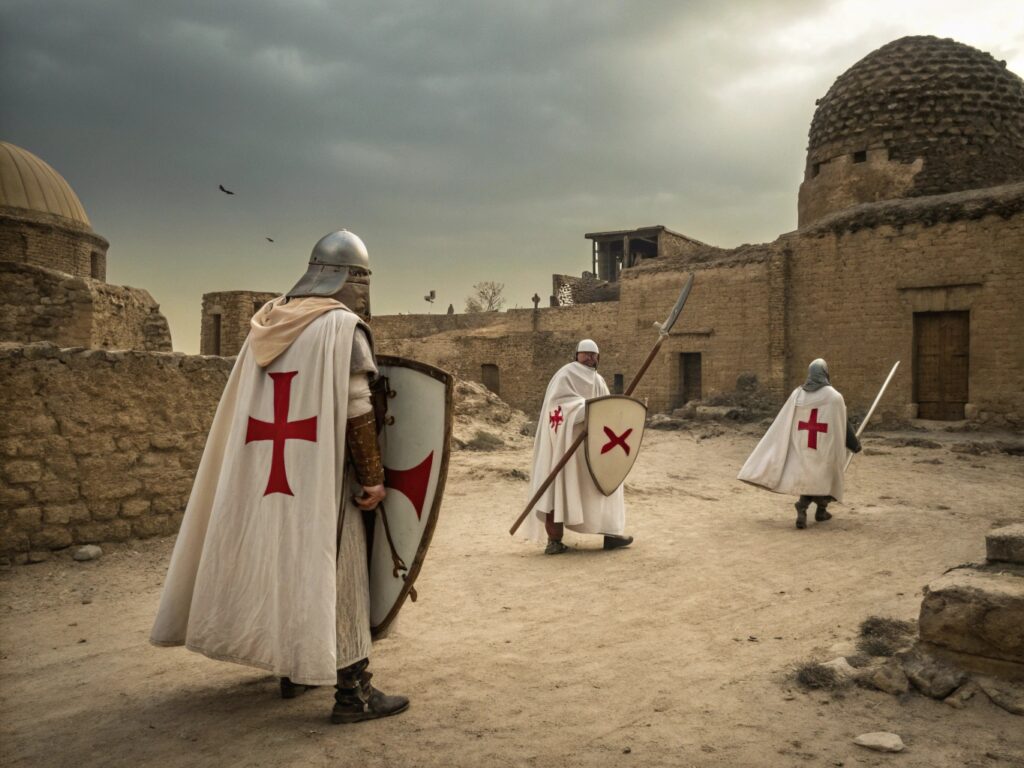
The Knights Templar are often associated with the grand cathedrals of France, the castles of England, and the secretive trials that led to their downfall. But to truly understand the Templar Order, one must look East—toward the Holy Land, where their mission was born and where their true legacy took shape.
From the sun-scorched walls of Jerusalem to the windswept strongholds of Acre and the desolate plains of Transjordan, the Templars in the Holy Land left enduring marks—military, spiritual, and architectural. This article explores their lesser-known but vital contributions to the Crusader states and the Christian struggle in the East.

1. Jerusalem: The Cradle of the Templar Order
It was in Jerusalem, not Europe, that the Templar Order began. Founded around 1119 AD by Hugues de Payens and a small group of knights, the Templars pledged to protect pilgrims journeying to the Holy City after its conquest during the First Crusade.
King Baldwin II granted them residence in the Al-Aqsa Mosque, believed at the time to be the Temple of Solomon—hence the name “Poor Fellow-Soldiers of Christ and of the Temple of Solomon.” The Templars transformed the building into their headquarters and spiritual heart.
From this sacred foundation, the Templar history in Jerusalem expanded rapidly. The Order soon became a powerful military and financial force, using Jerusalem as a base for training, diplomacy, and defense.
2. The Military Backbone of the Crusader States
The Holy Land was not a unified territory—it was a fragile patchwork of Crusader kingdoms and principalities constantly under threat. The Knights Templar in the Crusades became the shock troops of this Christian frontier.
Templars held key fortresses and garrisons along major routes and borderlands, often acting as the first line of defense against Muslim counterattacks. Their fierce discipline and willingness to fight to the death earned them a reputation among allies and enemies alike.
Templar knights wore no family crest—only the red cross on white, symbolizing martyrdom and purity. They often served in elite strike units, protecting supply lines, manning fortresses, and launching raids into enemy territory.
3. Fortresses of Faith and War: Templar Castles in the East
The Templar castles in the East were marvels of medieval military engineering. Built to withstand sieges and command strategic terrain, these fortresses became the backbone of Crusader defense.
Some of the most famous include:
-
Safed (Ṣafad): Rebuilt by the Templars in the 13th century, this stronghold in northern Galilee offered commanding views of trade routes and borders.
-
Château Pèlerin (Atlit Castle): One of the largest and most fortified Crusader castles, located along the coast near Haifa. It withstood multiple attacks and remained a Templar bastion until after the fall of Acre.
-
Gaston (Bagras): Located near Antioch, this fortress was a critical outpost controlling access between the Crusader States and Armenia.
-
Fortresses in Transjordan: Including sites like Vadum Iacob and Aqaba, which allowed the Templars to control travel routes across the Jordan River and into the desert.
These Templar strongholds in the Holy Land were not just military centers—they housed chapels, commanderies, stables, and armories. Life within their walls was a blend of monkish discipline and military vigilance.
4. Diplomacy, Trade, and Banking in the Levant
While the Templars are famed for warfare, their influence in the Levant extended into diplomacy and finance. As trusted agents of kings and popes, they often negotiated truces, managed ransoms, and brokered alliances with Muslim leaders like Saladin.
They also served as bankers to the Crusader states, managing treasuries, loans, and donations from Europe. Templar houses in the East became safe repositories for pilgrims’ wealth and operated as financial hubs supporting both spiritual and military operations.
Their infrastructure in the East—roads, ports, granaries, and trading posts—helped stabilize Christian presence in the region for nearly two centuries.
5. Spiritual Mission in the Land of Christ
Fighting for the Holy Land was not only about territory—it was seen as divine duty. The Templars viewed their service as an act of sacred warfare. Many knights believed they were defending not just cities and kingdoms, but the places where Christ had walked.
Templars participated in religious processions, donated to local churches, and guarded pilgrims visiting holy sites such as the Church of the Holy Sepulchre, Bethlehem, and the Mount of Olives.
Their presence reinforced the idea that the Crusader states were more than political experiments—they were spiritual colonies meant to preserve Christian access to sacred geography.
6. The Fall of Acre and the Retreat from the East
The final chapter of the Templars in the East came with tragedy. In 1291, Acre, the last major Crusader stronghold in the Holy Land, fell to the Mamluks after a brutal siege. The Templars fought heroically, holding their quarter of the city even after other forces collapsed.
Their final stand took place in the Templar Tower, which withstood waves of attackers before being overrun. Many knights died in battle or were executed after surrendering. With the fall of Acre, the Templar presence in the Holy Land was effectively extinguished.
The surviving knights retreated to Cyprus, marking the end of an era—and the beginning of their decline in the West.
7. Forgotten Footprints and Modern Discoveries
Today, many of the Templar sites in the Holy Land lie in ruins, buried beneath modern cities or standing as archaeological remains. But new discoveries continue to shed light on their presence.
Excavations in Acre, Atlit, and Safed have uncovered walls, coins, weapons, and documents that attest to the Templars’ administrative, military, and spiritual lives. Historians now emphasize the Order’s adaptability, logistical brilliance, and intercultural negotiations in a land where faith and warfare collided daily.
Despite their eventual fall, the Templars in the East left behind a legacy of resilience, sacrifice, and unyielding devotion to their cause.
Conclusion: The Eastern Legacy of the Western Order
While European cathedrals and court intrigue often dominate Templar lore, it was in the Holy Land that the Order truly forged its identity. The forgotten footprints of the Templars—castles, treaties, prayers, and blood—are etched into the soil of the Levant.
To walk through the remains of Château Pèlerin or stand on the Temple Mount is to feel the echo of boots, hooves, and whispered prayers from a vanished brotherhood. These knights were not only warriors—they were guardians of an impossible dream, struggling to anchor heaven to earth in the land where heaven once touched it.
The Templars in the Holy Land were not mere visitors. For nearly 200 years, they were builders, protectors, and pilgrims—leaving behind a legacy far deeper than legend.