
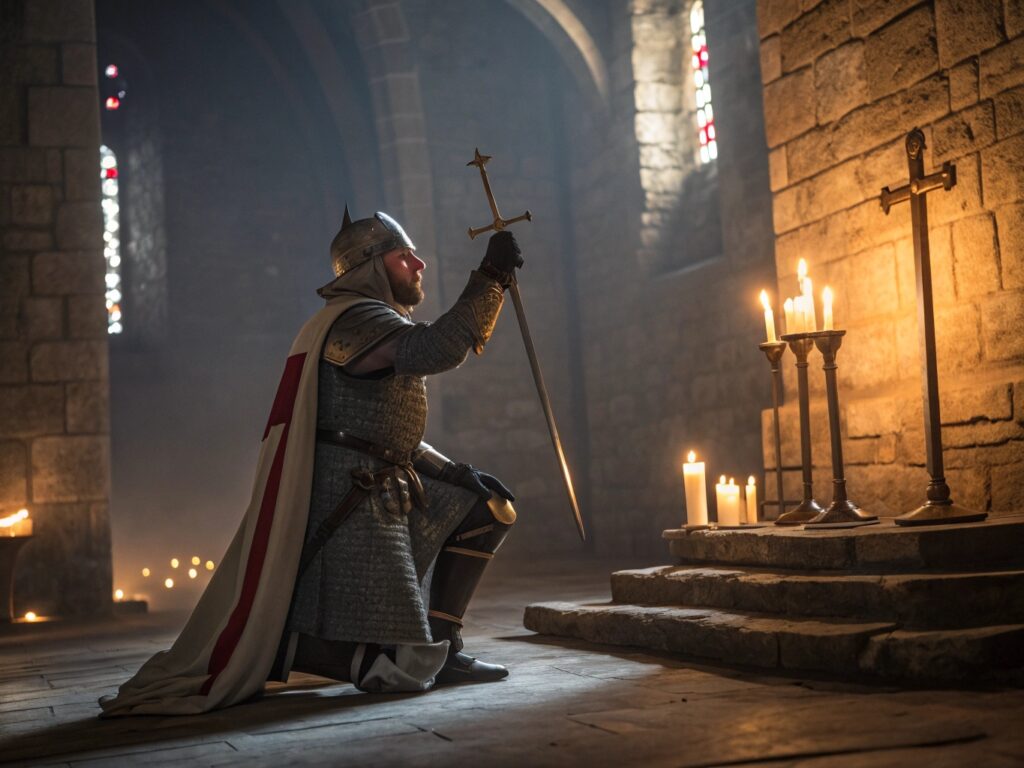
Few religious orders in history have blended faith and warfare as completely as the Knights Templar. To their enemies, they were ruthless crusaders; to their brethren, they were monastic warriors serving the will of God.
At the heart of their creed stood one powerful image — Christ as the Warrior King, the divine commander leading His army of the faithful into a spiritual and earthly battle against evil.
This idea shaped Templar theology, guided their sense of duty, and justified their role as protectors of Christendom.
Christ the Commander: The Foundation of Templar Faith
The Templar religious beliefs were not born from simple militarism. They were rooted deeply in the belief that Christ Himself was both King and Warrior, the righteous conqueror of sin and death.
While medieval Christianity often portrayed Jesus as the gentle shepherd, the Templars found inspiration in the Book of Revelation, where Christ rides forth on a white horse, leading heavenly armies.
In this apocalyptic vision, the Templar view of Christ reflected a theology of divine justice and holy warfare. To them, battle was not just physical; it was a sacred struggle mirroring the eternal conflict between light and darkness. Each sword stroke symbolized a prayer — each victory, a triumph of faith.
The Influence of Bernard of Clairvaux and the “New Knighthood”
A cornerstone of Knight Templar theology came from Bernard of Clairvaux, the Cistercian monk who wrote De Laude Novae Militiae (“In Praise of the New Knighthood”).
In this work, Bernard redefined the meaning of Christian knighthood. He argued that a true knight fought not for worldly glory, but for the defense of God’s kingdom.
Bernard described the Templar as “gentle among the faithful, fierce toward the unbeliever.” To kill for Christ was not murder but divine justice — a paradox that only made sense through the Templars’ concept of holy war and Christianity intertwined.
Through Bernard’s influence, the Templars became the embodiment of Christian chivalry and faith, uniting spiritual warfare and physical defense into one divine calling.

Holy War as Spiritual Duty
To understand how the Templars reconciled faith and violence, one must explore their theology of battle and redemption.
Unlike secular knights, who fought for lords or crowns, the Knights Templar fought for the salvation of souls — including their own.
Every crusade, every skirmish, every defense of pilgrims was viewed as a penance, a way to purge sin through sacred duty. The battlefield became their monastery; their armor, a robe of prayer.
This understanding of spiritual warfare in Templar theology allowed them to act without fear. Death was not defeat but resurrection and immortality, for those who fell in battle were seen as martyrs of the faith, reborn in Christ’s eternal army.
Their courage stemmed not from arrogance but from absolute belief in divine protection. The Templar knight charged forward believing that Christ the Warrior King rode with him — an invisible general commanding legions of angels.
Christ the Warrior King: Biblical Roots and Symbolism
The Templar idea of Christ as a warrior-king was not a medieval invention. It drew heavily from the Old Testament’s image of God as a defender of Israel, and from the New Testament’s portrayal of Christ’s victory over evil.
In the Psalms, God is described as a mighty fortress; in Revelation, He becomes a conqueror.
This dual nature — merciful redeemer and divine warrior — resonated deeply with the Templars’ devotion to Christ.
For them, Christ’s crucifixion was the ultimate battle — a cosmic confrontation between divine light and infernal darkness.
The cross on their chest symbolized both suffering and victory, reminding them that the same Savior who died in humility now reigns in heavenly power.
Thus, Christ the King symbolism guided their every act of faith and knighthood.
Templar Devotion and Prayer: The Sword as a Symbol of Faith
Despite their militant mission, the Templars were first and foremost monks. Their days began and ended with prayer, fasting, and confession.
Yet their rituals were infused with martial symbolism. The sword, polished and sanctified, represented the Word of God — sharp enough to pierce sin, strong enough to defend truth.
In this sense, Templar devotion to Christ was both contemplative and active.
When a knight drew his blade, he invoked not vengeance but divine justice. His strength came not from muscle but from Christian chivalry and faith.
They saw themselves as instruments of heaven, wielded by the hand of Christ the Commander.
Their sacred duty was to build God’s kingdom on earth — a spiritual meaning of Crusades that transcended politics. They fought not merely for Jerusalem, but for the New Jerusalem, the heavenly city promised to the righteous.
The Temple Within: The Mystical Side of Templar Theology
While much of Templar theology appeared martial, it also had profound mystical undertones.
The “Temple” they defended was not just the ruins of Solomon’s Temple in Jerusalem — it symbolized the inner soul purified by faith.
This idea reflected the influence of early Christian mysticism, where the body was seen as God’s temple, and the ultimate battle was fought within.
In this inner struggle, Christ the Warrior King became the liberator of the soul, breaking the chains of sin and ignorance.
To conquer oneself was to win the truest victory.
Thus, the Templars’ religious symbolism went far beyond swords and shields; it was about transforming the heart into a fortress of divine light.
Faith Under Fire: Courage, Martyrdom, and Redemption
Templar chronicles often tell of knights facing hopeless odds — yet refusing to retreat.
This fearless spirit arose from their belief in resurrection and immortality. To die defending the faith was to share in Christ’s victory.
Many Templars went to the battlefield after confession, believing that if they fell, their souls would ascend directly to heaven.
This understanding of martyrdom and divine justice made them some of the most disciplined and formidable warriors of the Crusades.
Their deaths were not meaningless — each one echoed the theology of sacrifice and redemption that defined their order.
They saw themselves as living extensions of Christ’s battle against darkness — proof that faith and knighthood could coexist without contradiction.
Templar Legacy: The Enduring Image of Christ the King
When the Templar Order was destroyed in the early 14th century, their spiritual legacy endured.
Artists, mystics, and theologians continued to explore the idea of a warrior Christ — the defender of truth, the righteous judge, the Warrior King of heaven.
Modern scholars view this not as fanaticism but as a profound synthesis of spiritual and temporal ideals.
To the Templars, every act of courage, mercy, or sacrifice was a mirror of Christ’s own nature — both lion and lamb, conqueror and redeemer.
Their story reminds us that true spiritual warfare is not about conquest but transformation — the courage to stand against evil in all its forms, within and without.
Conclusion: The Eternal Commander
The Hidden Theology of the Templars reveals a faith of paradox — a religion of peace embodied by soldiers of war.
In Christ the Warrior King, they found not contradiction but harmony: the perfect balance of justice and mercy, power and humility.
Through this vision, the Knights Templar became more than crusaders; they became symbols of devotion, obedience, and courage.
Their swords are long gone, but their belief endures — that every soul called to serve righteousness marches under the same eternal banner:
Christ, the King of Kings, the Warrior who conquers through love.